National Museum of Korea Is Now the World’s 3rd Most Visited Museum – And It’s Still Free (2026)
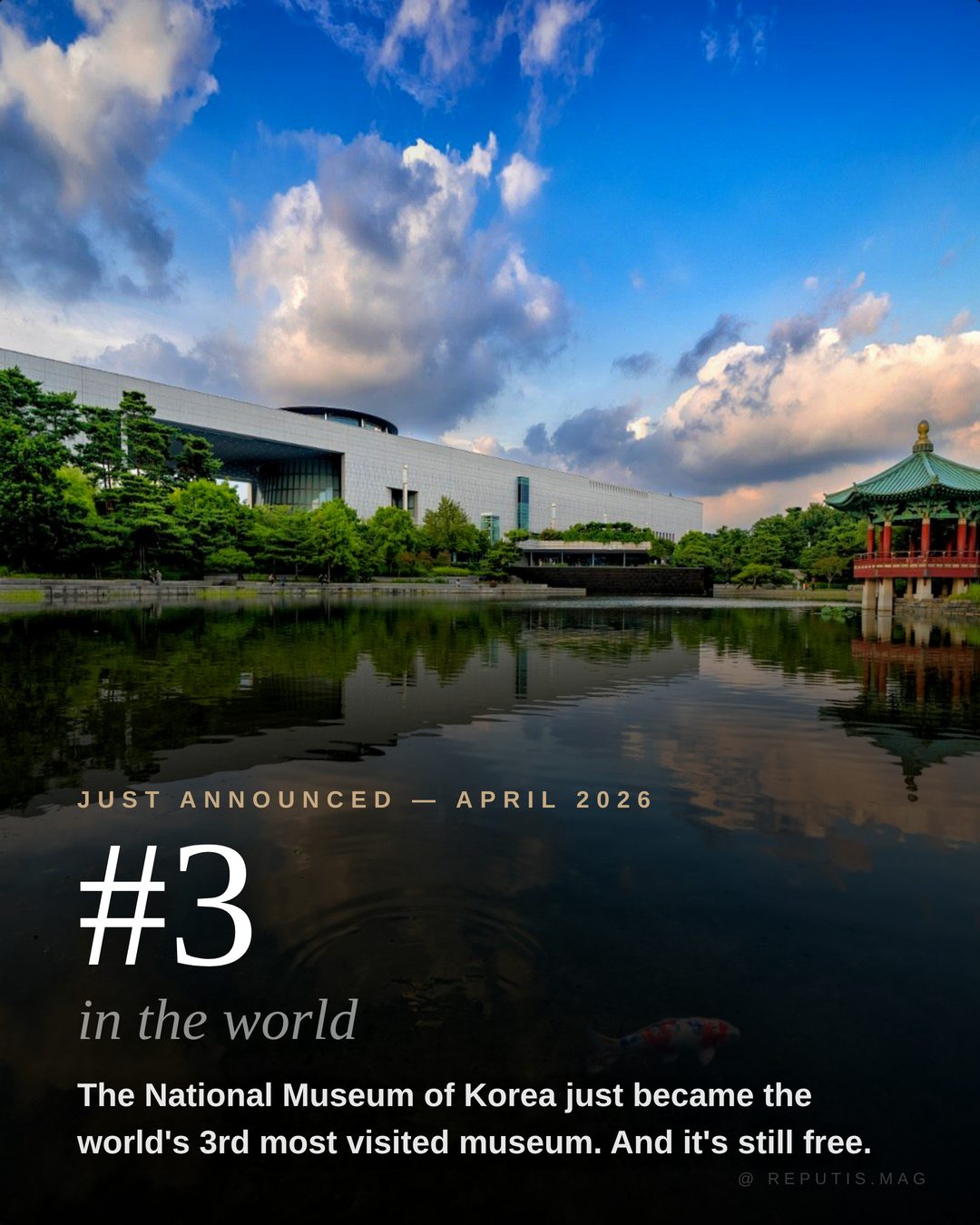
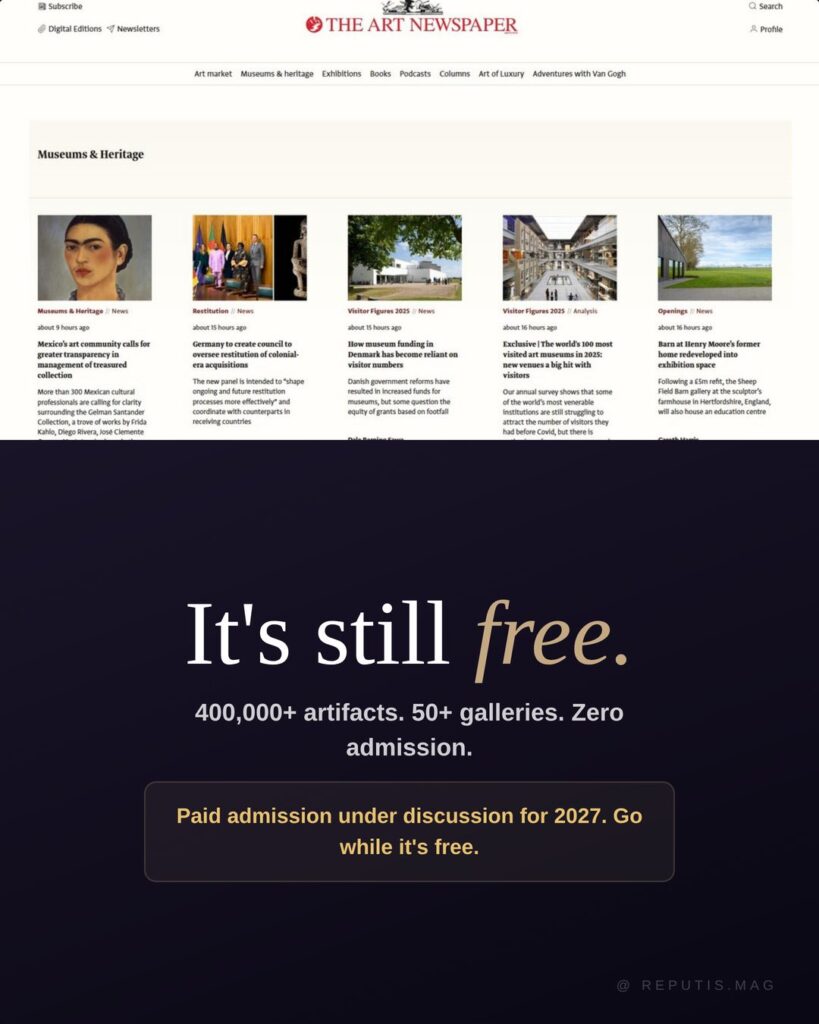
On March 31, 2026, The Art Newspaper released its annual global museum attendance survey. The National Museum of Korea came in third — behind only the Louvre and the Vatican Museums.
It beat the British Museum. It beat the Met. And unlike almost every other museum in the top five, it charges nothing to enter.
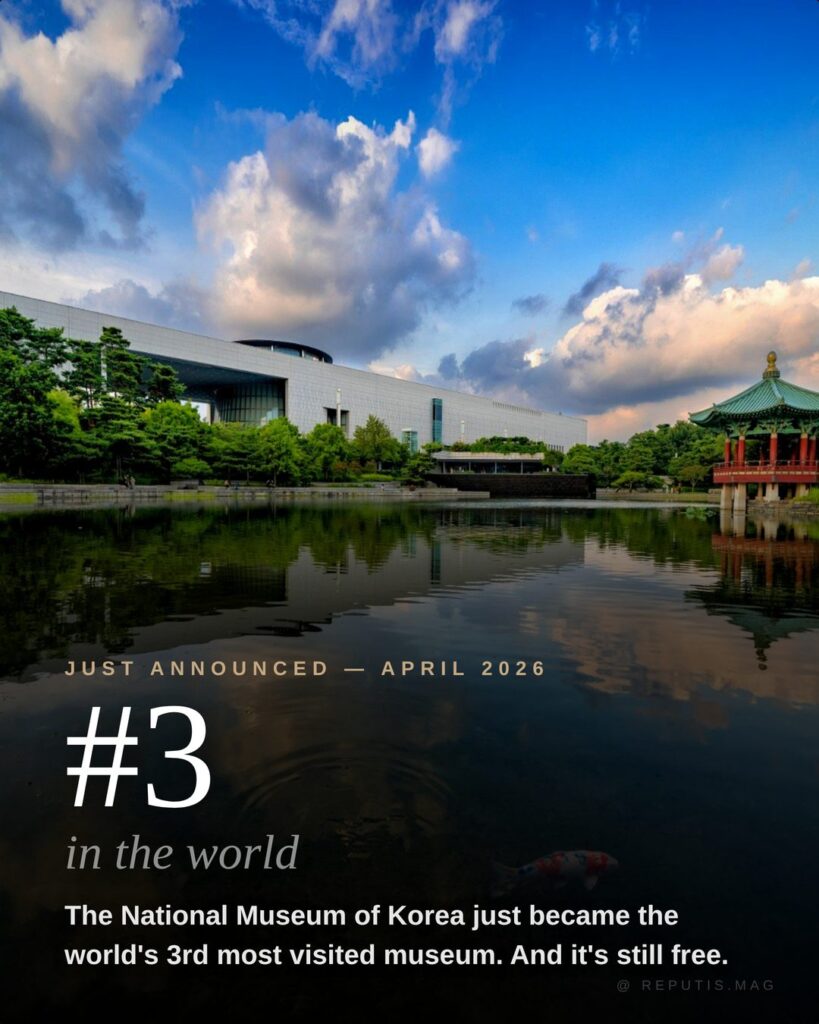
Here’s what the numbers say, what’s on right now, and why you might want to go sooner rather than later.
The 2025 Global Museum Ranking
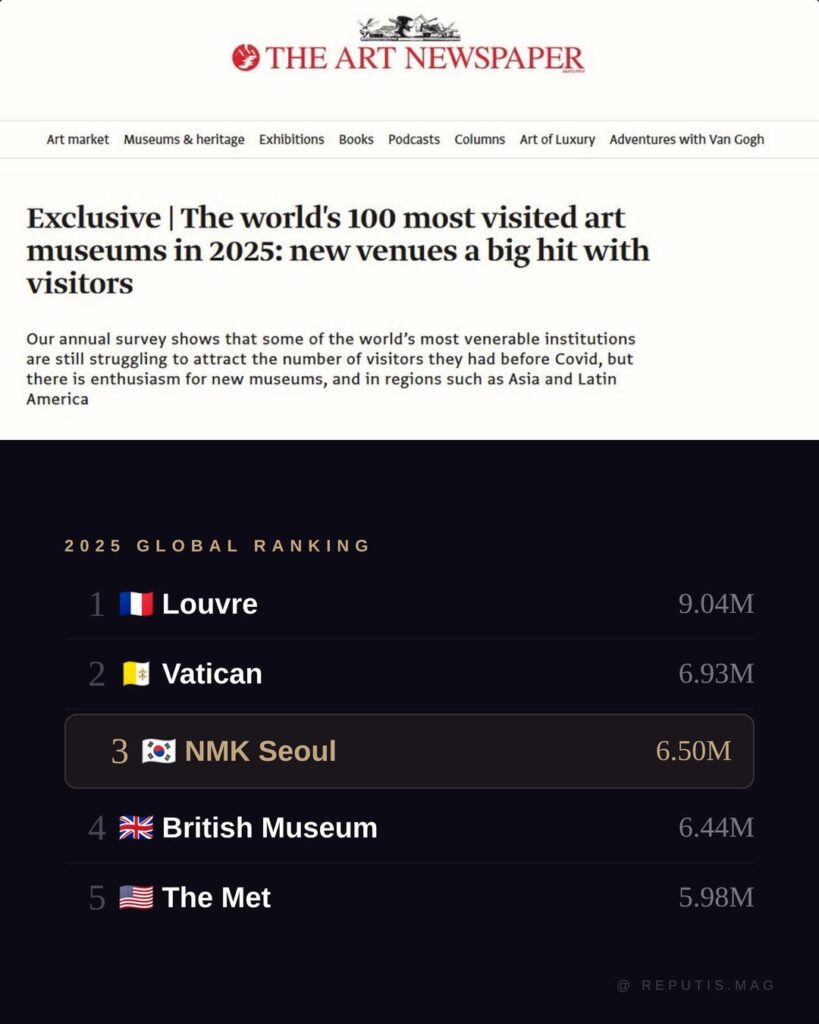
The Art Newspaper’s annual Visitor Figures survey tracks attendance at the world’s top museums. The 2025 results, released on March 31, 2026, placed the National Museum of Korea at number three globally — a position it has never held before.
| Rank | Museum | 2025 Visitors |
|---|---|---|
| 1 | Louvre (Paris) | 9,046,000 |
| 2 | Vatican Museums | 6,933,822 |
| 3 | National Museum of Korea (Seoul) | 6,507,483 |
| 4 | British Museum (London) | 6,440,120 |
| 5 | Metropolitan Museum of Art (New York) | 5,984,091 |
The Art Newspaper described Korea as showing “the most spectacular rise” of any country in the survey. Five Korean museums in total made the global top 100, including the National Museum of Modern and Contemporary Art Seoul at number 35, the Gyeongju National Museum at 39, and the Buyeo and Gongju national museums at 78 and 89.
The Growth: +70% in a Single Year
What makes this ranking remarkable is not just the position — it’s the speed of the climb. The National Museum of Korea drew 3.8 million visitors in 2024. In 2025, that number jumped to 6.5 million — a year-over-year increase of more than 70 percent.
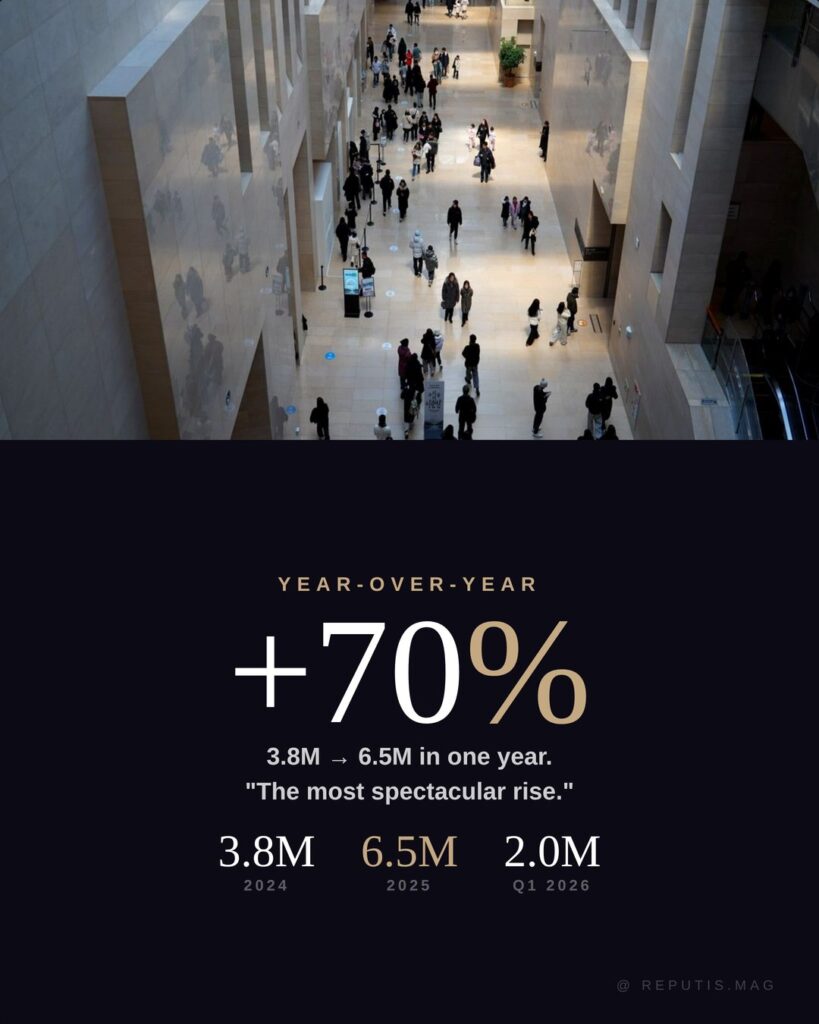
The Art Newspaper noted that this was “one of the largest absolute increases we have ever recorded.” The growth was not isolated to the main Seoul site either. Branch museums across Korea — in Jinju, Gyeongju, Cheongju, Buyeo, and Iksan — all reported significant attendance increases. The combined network of national museums across the country reached 14.7 million visitors, a record.
The momentum has continued into 2026. In the first quarter alone, the museum recorded 2,023,888 visitors — up 44.8 percent compared to the same period last year.
It’s Still Free — But That May Change
Unlike the Louvre, the Vatican Museums, and the Met (which charges a recommended admission), the National Museum of Korea’s permanent collection remains entirely free to the public. There is no ticket, no suggested donation, no reservation required. You walk in, and you’re in.
The museum houses more than 400,000 artifacts across 50-plus galleries spanning Korean history from the Paleolithic era to the modern period. Special exhibitions occasionally require separate paid tickets, but the core experience — the one that drew 6.5 million people last year — costs nothing.
However, there are signs this could change. Museum Director Yoo Hong-jun publicly stated in October 2025 that he intended to begin preparations for paid admission by the first half of 2026. Then, on March 30, 2026, the Ministry of Planning and Budget included paid admission conversion in its 2027 budget guidelines.
Both the ministry and the museum have clarified that nothing has been decided. But the direction of the conversation is clear. If you have been meaning to visit, the free window may not last indefinitely.
What’s on Right Now
The museum’s exhibition program in 2026 is one of its strongest in years.
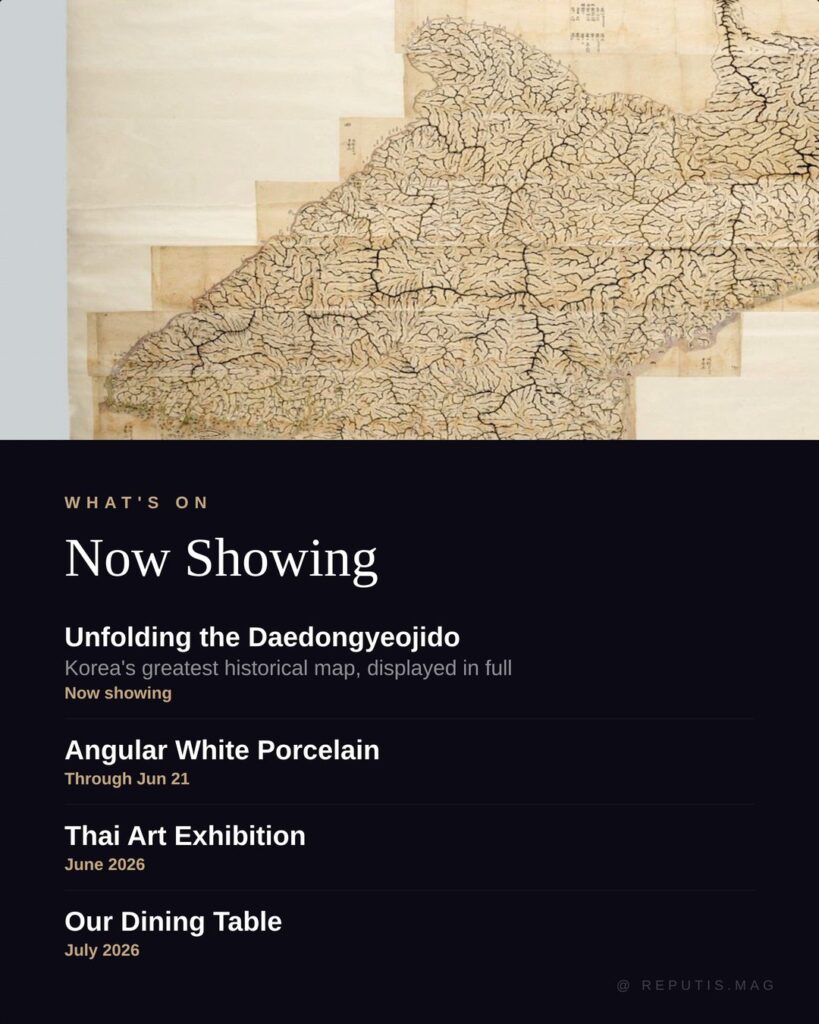
Unfolding the Daedongyeojido is the current highlight. Since February 12, 2026, all 22 panels of Kim Jeong-ho’s 1861 masterwork — Korea’s most significant historical map — have been displayed in full on the first-floor “History Road.” Printed on traditional hanji paper from the museum’s high-resolution scan, the assembled map measures 6.7 meters tall and 3.8 meters wide. It is a permanent installation with no end date.
Angular White Porcelain runs through June 21 in the Buncheong and White Porcelain Gallery, examining geometric forms in Joseon-era ceramics.
The Conservation Science Center, which opened in October 2025, hosts a special exhibition on artifact preservation through June 30.
Looking ahead, a Thai Art Exhibition opens in June, followed by Our Dining Table in July — an exhibition exploring Korean food culture through heritage objects. November brings a Kunsthaus Zürich collection showcase, and December features Marie Antoinette Style.
Visitor Tips for 2026
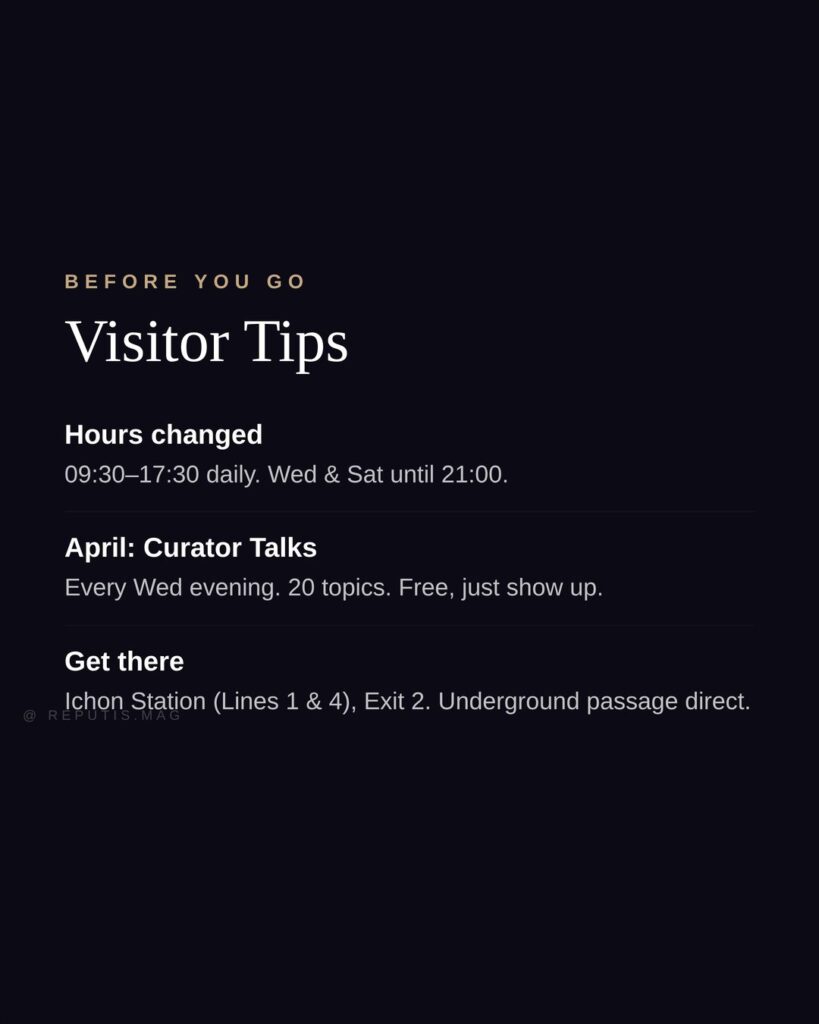
Hours have changed. As of March 16, 2026, the museum opens 30 minutes earlier. New hours are 09:30 to 17:30, Tuesday through Sunday. Wednesday and Saturday evenings extend to 21:00.
April: Curator Talks. Every Wednesday evening in April, during the extended night hours (18:00 to 21:00), the museum runs “Curator Conversations” — 20 themed talks across all permanent galleries. Topics range from Silla gold crowns to climate change and human history. No reservation required, no fee. Just show up.
Closed days in 2026: Seollal (Lunar New Year), Chuseok, and the first Monday of June, September, and December.
How to get there: Take Seoul Metro Line 1 or Line 4 to Ichon Station. Exit 2 connects directly to the museum through an underground passage — no street crossing, no navigation needed. The walk takes about five minutes.
| Address | 137 Seobinggo-ro, Yongsan-gu, Seoul |
| Hours | Tue–Sun, 09:30–17:30 (Wed & Sat until 21:00) |
| Admission | Free (permanent collection) |
| Nearest station | Ichon Station (Lines 1 & 4), Exit 2 |
| Website | museum.go.kr |
Why This Matters
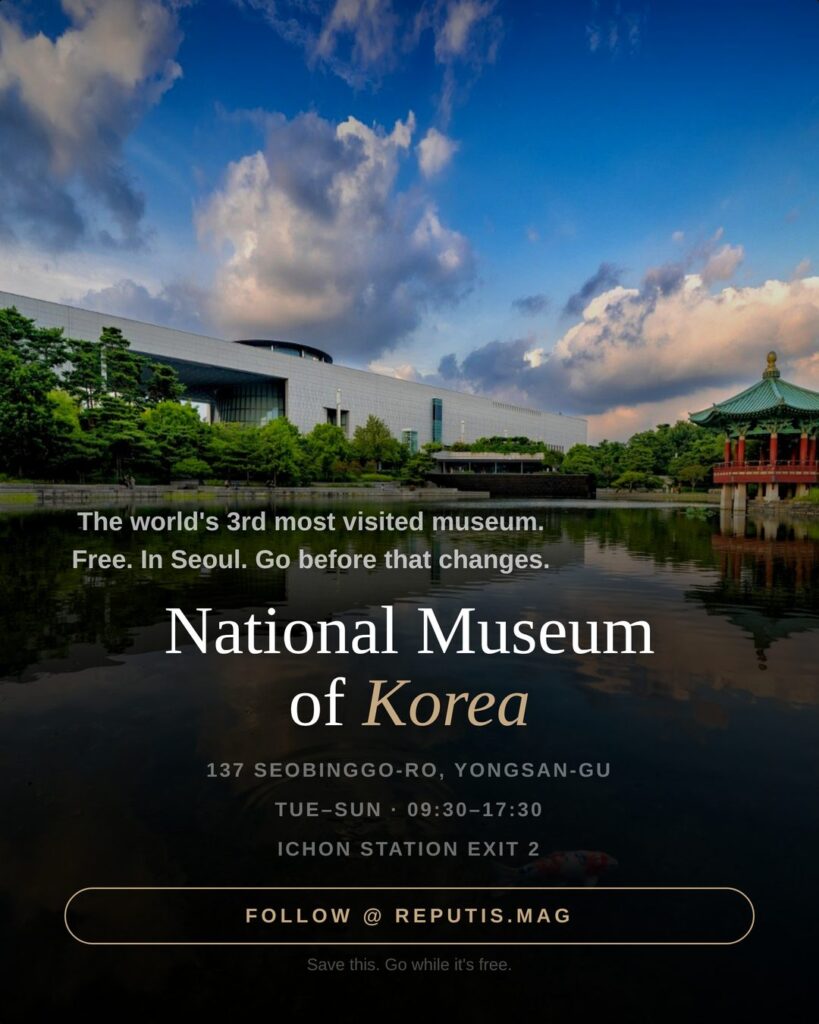
A national museum does not jump 70 percent in attendance by accident. The Art Newspaper attributed the surge to the global momentum of K-culture, but the museum itself points to a combination of factors: exhibition planning that balances permanent and special shows, digital innovation like the immersive Silgam (Digital Immersive) Gallery, and participatory programs that have drawn younger visitors in record numbers.
The Lee Kun-hee Collection, donated by the late Samsung chairman, has also played a role — its touring exhibition drew roughly 80,000 visitors in Washington, D.C. alone, and curator-led video explanations of the collection surpassed one million views online.
The museum’s merchandise and heritage-inspired products hit a new annual sales record of over 40 billion won in 2025, reflecting an appetite for Korean cultural heritage that extends well beyond gallery walls.
Whether you are a first-time visitor or a regular, the museum is currently operating at a level of ambition and public engagement that matches its new global standing. And for now, the price of admission is still zero.
Go while that lasts.
Words and research by @reputis.mag. Follow us for Seoul culture, K-beauty, and travel you won’t find in guidebooks.
:: Recent Posts ::
- National Museum of Korea Is Now the World’s 3rd Most Visited Museum – And It’s Still Free (2026)
- Cosmetics e-Labels? South Korea to Become the 1st Country to Legislate
- Bored and Hungry Seoul : World’s 1st NFT Burger Joint in Seongsu-dong
- Haus Nowhere Seoul: The Ultimate Guide to Seongsu’s 14-Story Future of Retail (2026)
- NVIDIA × L’Oréal: How GPUs Are Entering the Beauty Lab at GTC 2026

당신이 좋아할 만한

2026 K-Beauty Exhibition in Paris Everyone’s Talking About
HeyPOP App Guide: How to Discover Seoul’s Best Pop-Up Stores in 2025