NVIDIA × L’Oréal: How GPUs Are Entering the Beauty Lab at GTC 2026
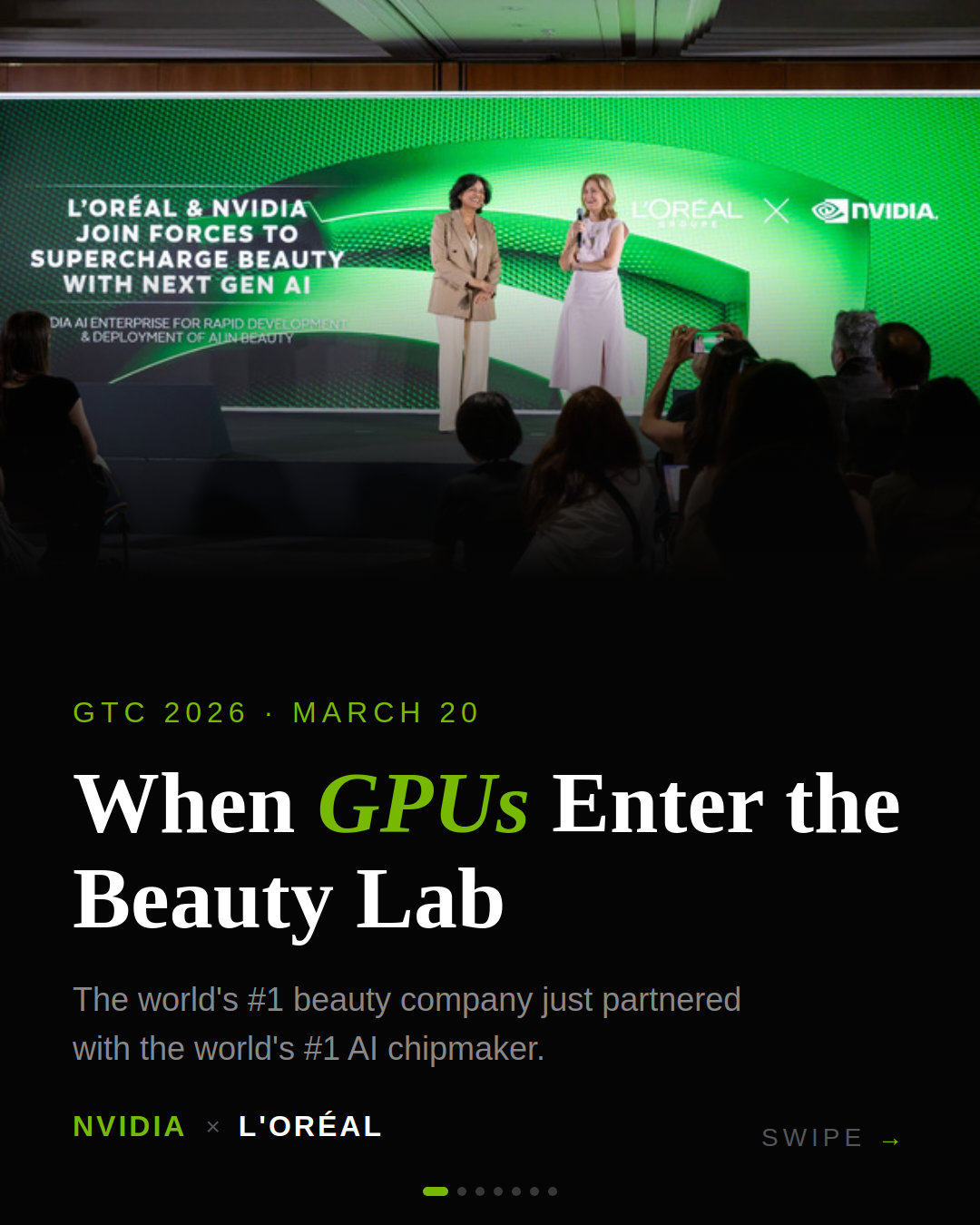
On March 17, 2026, at NVIDIA’s annual GPU Technology Conference (GTC) in San Jose, California, the world’s largest beauty company made a move that caught the tech and investment worlds off guard.
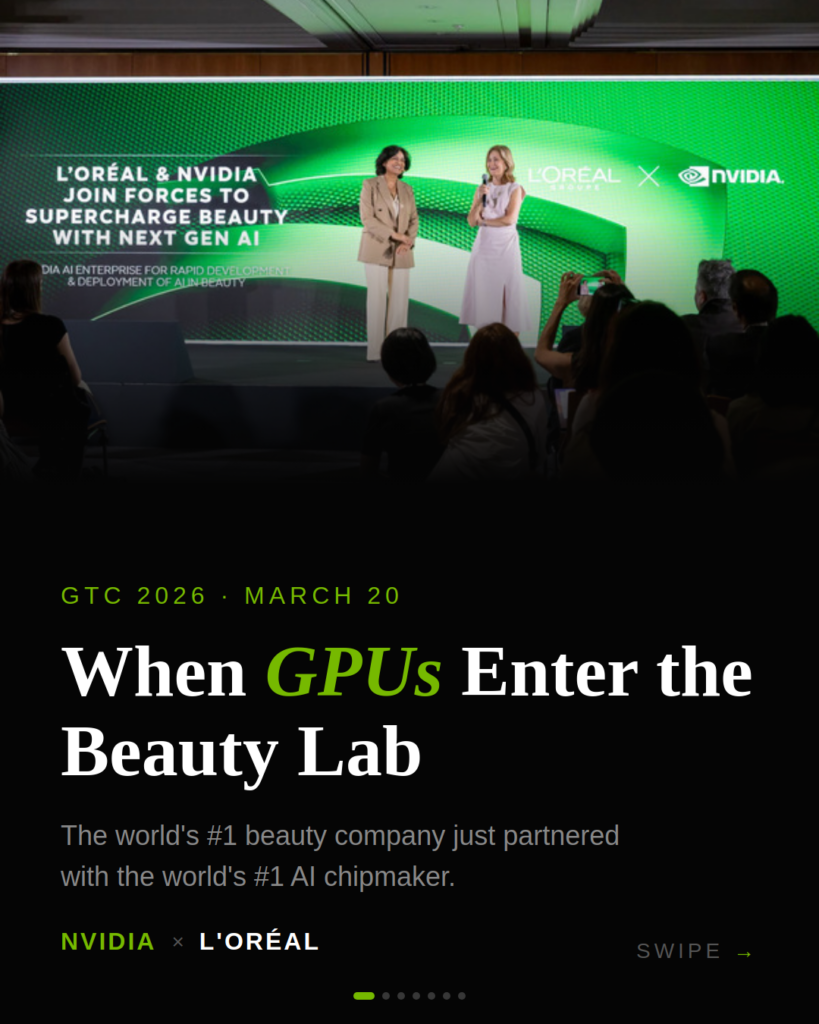
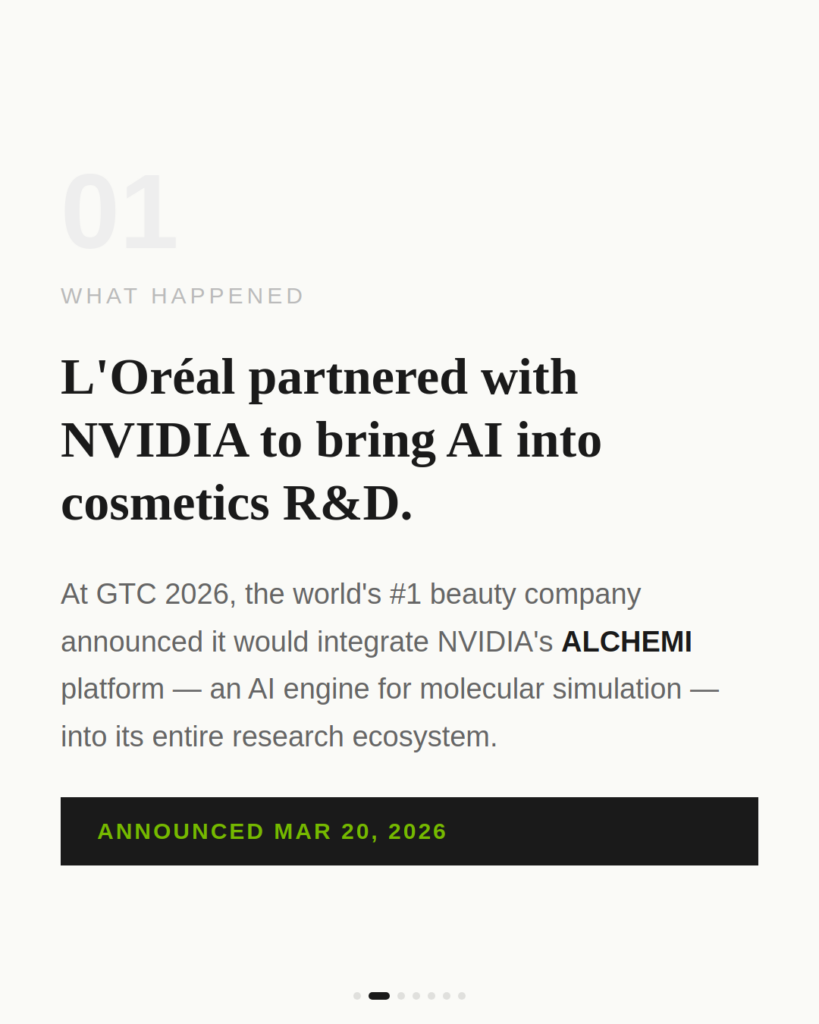
L’Oréal announced the expansion of its AI partnership with NVIDIA, integrating the chipmaker’s molecular simulation platform directly into its R&D operations.
A semiconductor company and a cosmetics giant — it’s an unlikely pairing. But behind this partnership lies a story about slowing growth, K-Beauty disruption, and the race to make speed the ultimate competitive advantage in beauty.
What Happened at GTC 2026
At GTC 2026 — NVIDIA’s flagship AI conference held March 16–19 — L’Oréal revealed it would integrate NVIDIA ALCHEMI, a machine learning framework for computational chemistry, directly into its Research and Innovation (R&I) ecosystem.
This isn’t L’Oréal’s first collaboration with NVIDIA. The two companies initially partnered in June 2025 to apply AI to marketing and advertising — generating 3D digital renderings of products for packaging and campaign design. But this expansion moves the partnership into an entirely different territory: core product R&D.
“Our collaboration with NVIDIA brings definitively a new dimension into our L’Oréal Research labs,” said Barbara Lavernos, Deputy CEO in charge of Research, Innovation and Technology at L’Oréal. “By applying AI-powered molecular simulation to our most proprietary actives, we are bridging atomic-scale discovery with real-world consumer benefit.”
What Is NVIDIA ALCHEMI?
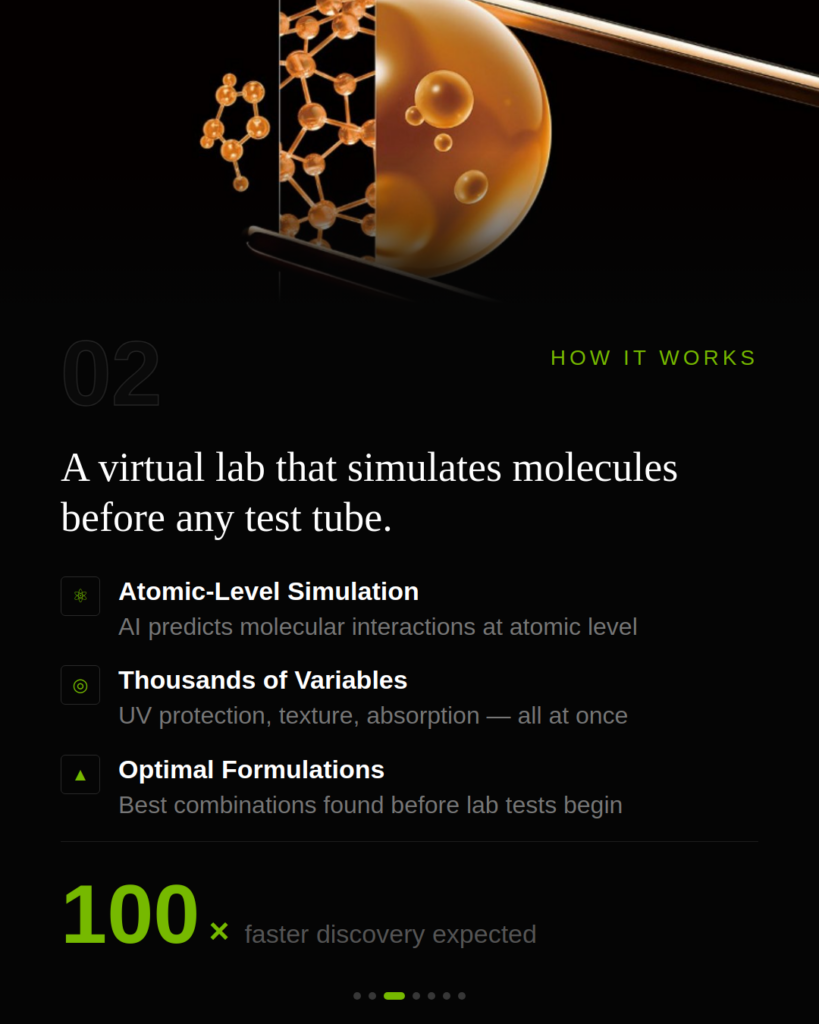
ALCHEMI is NVIDIA’s collection of domain-specific pre-trained models trained on quantum chemistry data, combined with a suite of simulation tools. Think of it as a virtual laboratory that can predict how molecules behave and interact at the atomic level — before a single physical experiment takes place.
Here’s how it works in L’Oréal’s R&D pipeline:
1. Atomic-Level Simulation
The AI engine predicts how chemical molecules interact at the atomic scale. For example, when developing a new sunscreen formula, it can model how specific ingredients combine to reflect UV radiation — and how those combinations feel on skin.
2. Thousands of Variables, Simultaneously
Traditional lab testing evaluates one formulation at a time. ALCHEMI can analyze thousands of variables simultaneously — UV protection levels, skin texture, absorption rates, preservation stability — in a digital environment.
3. Optimal Formulations Before Lab Testing
By identifying the most promising molecular combinations computationally, L’Oréal’s scientists can focus physical lab work on pre-validated candidates rather than running blind experiments.
The result, according to L’Oréal: a discovery process up to 100× faster than traditional methods.
“By integrating NVIDIA ALCHEMI into its R&D workflows, L’Oréal can simulate ingredient performance at an atomic scale, accelerating breakthrough discoveries in formulation.”— Azita Martin, VP & GM of AI for Retail and CPG, NVIDIA
The initiative is initially focused on two areas: photoprotection (UV defense) and skin tone management — both scientifically demanding fields where improved active ingredients can materially change product performance.
Why L’Oréal Needs This Now
This isn’t a company chasing a trend. It’s a company responding to a structural challenge.
Revenue Growth Is Decelerating
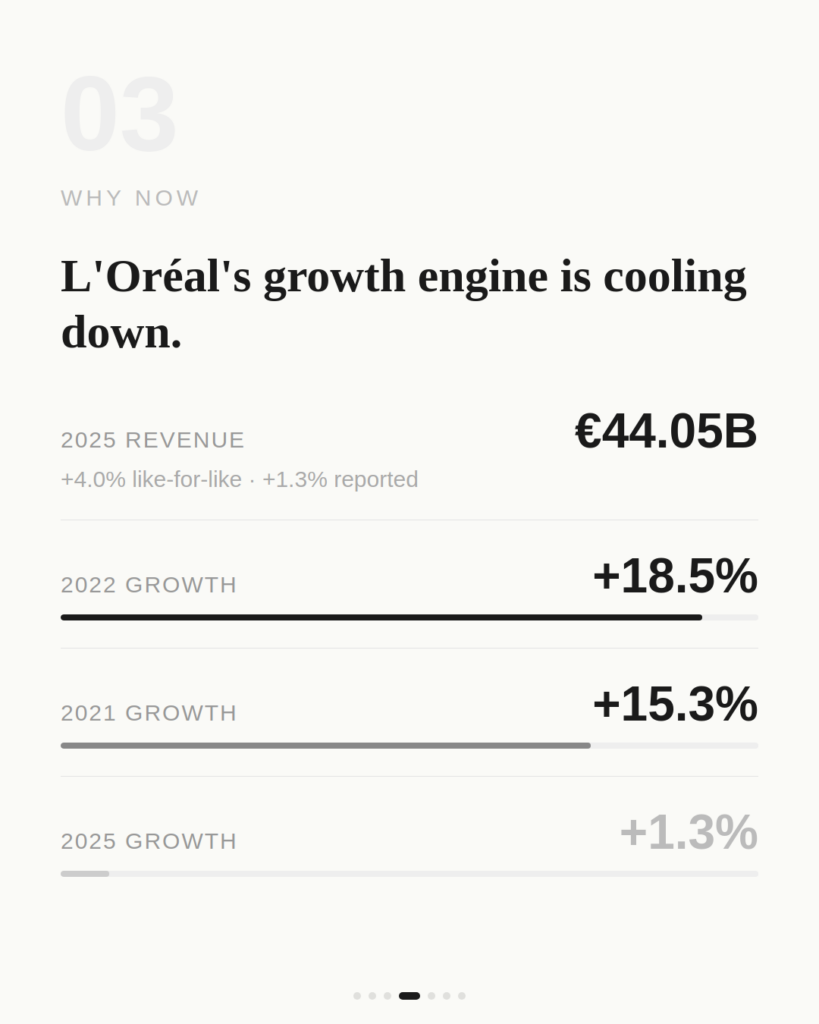
L’Oréal’s 2025 annual results tell the story:
| Year | Revenue | Reported Growth | Like-for-Like Growth |
|---|---|---|---|
| 2021 | €32.28B | +15.3% | — |
| 2022 | €38.26B | +18.5% | — |
| 2025 | €44.05B | +1.3% | +4.0% |
While the +4.0% like-for-like growth still outpaced the global beauty market (~3.5%), the reported figure of +1.3% — dragged down by a -3.6% currency headwind — marks a dramatic slowdown from the double-digit expansion years.
China and Indie Brands Are Squeezing Margins
Two forces are compressing L’Oréal’s dominance:
- China’s “Guochao” (national trend) movement — Local brands like Proya and Perfect Diary have captured market share from Western incumbents, fueled by patriotic consumer sentiment.
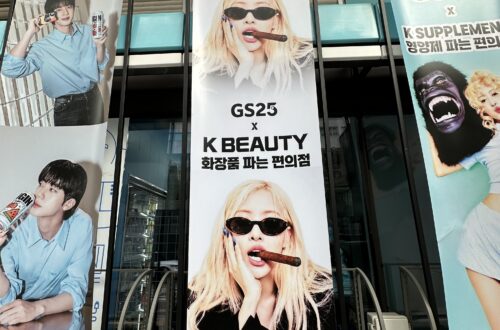
- K-Beauty’s indie brand explosion — Small Korean manufacturers are launching products at a pace L’Oréal’s traditional R&D cycle simply cannot match.
The K-Beauty Speed Gap
This is perhaps the most telling data point in the entire story:
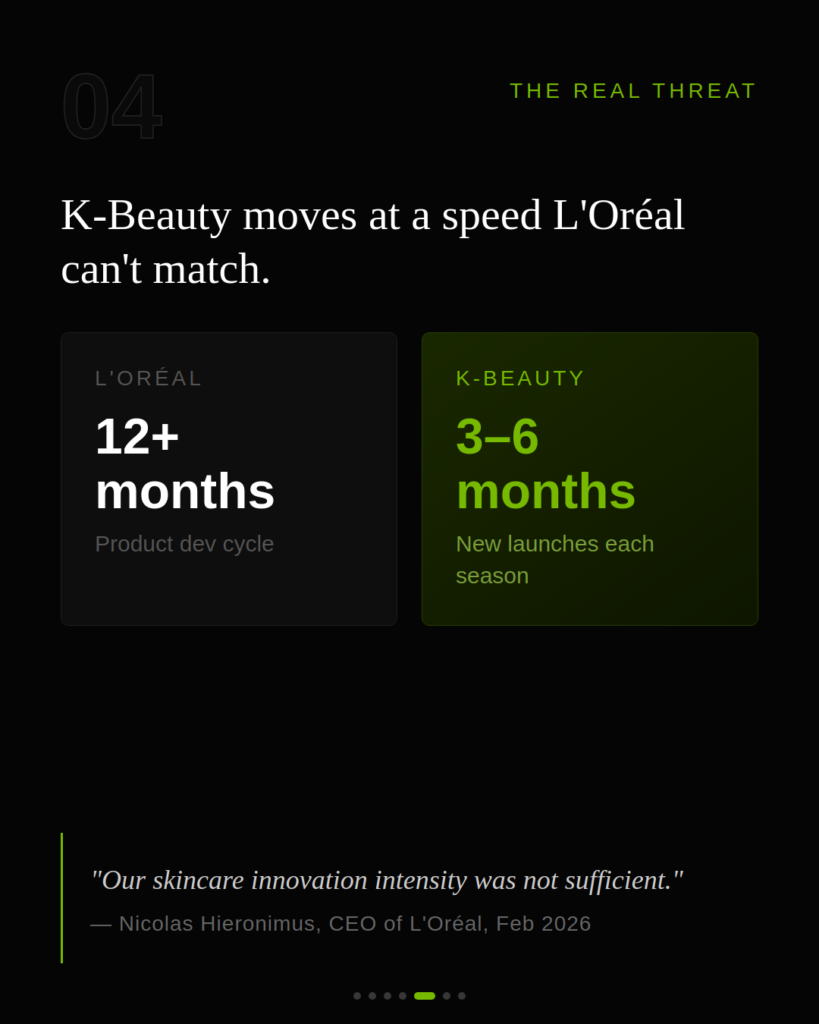
Korean indie beauty brands are shipping new products every 3–6 months. L’Oréal’s development cycle takes 12 months or more. In an industry where trends can go viral and fade within weeks, this gap is existential.
In L’Oréal’s February 2026 earnings call, CEO Nicolas Hieronimus made a rare public admission: “Our skincare innovation intensity was not sufficient.” It was the first time L’Oréal’s leadership explicitly cited indie brand proliferation as a factor in their skincare division’s underperformance.
The company is already adapting. L’Oréal Paris launched a “Revitalift Glass Skin” line — directly inspired by K-Beauty’s signature aesthetic — and has been aggressively increasing outsourcing to Korean ODM (Original Design Manufacturer) partners to compress development timelines.
3 Investor Signals You Shouldn’t Ignore
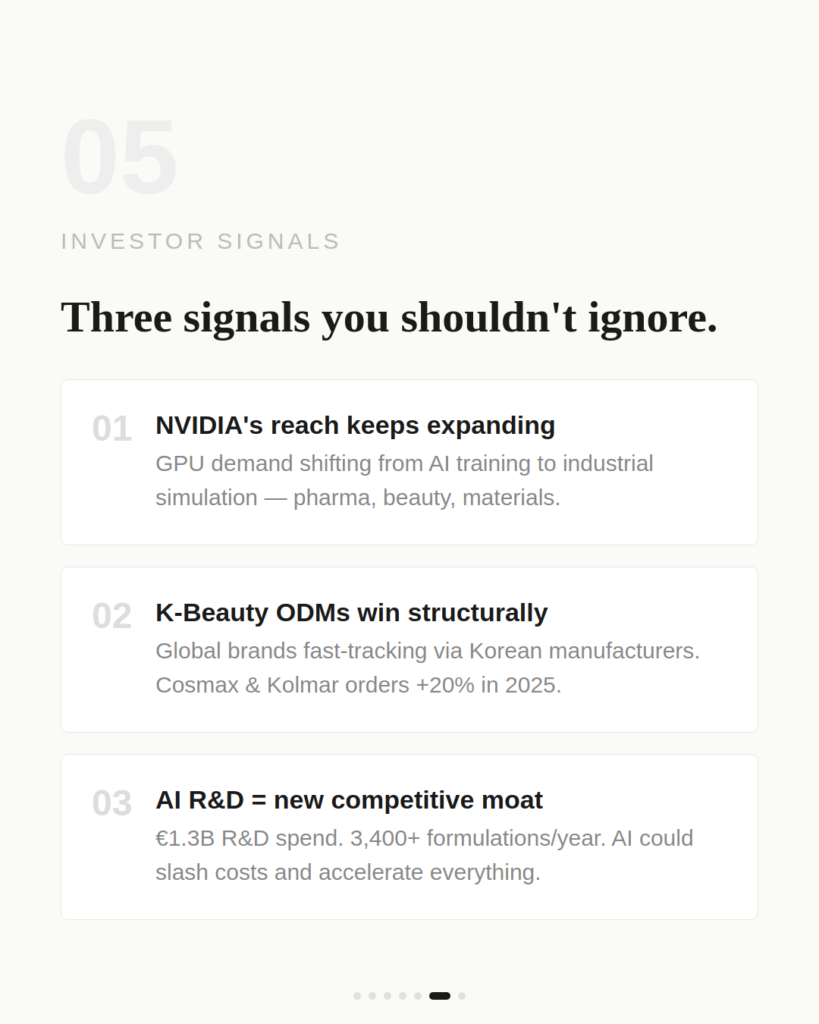
Signal 1: NVIDIA’s Reach Is Expanding Beyond Data Centers
This partnership is part of a broader pattern. At GTC 2026, NVIDIA also announced that Eli Lilly launched the pharmaceutical industry’s largest AI factory. GPU demand is shifting from AI model training to industrial-scale simulation — in pharma, materials science, and now beauty.
For NVIDIA investors, this diversification matters. It reduces dependence on the hyperscaler capex cycle and opens entirely new verticals for GPU compute.
Signal 2: Korean ODM Manufacturers Are Winning Structurally
As global beauty giants race to match K-Beauty’s speed, Korean contract manufacturers are becoming indispensable. Cosmax and Kolmar Korea both reported 20%+ year-over-year order increases from top-tier global brands in 2025.
The dynamic has fundamentally shifted: where global brands once dictated formulations to ODMs, Korean manufacturers are now proposing recipes and formulations that brands adopt. If AI accelerates the molecular discovery phase, the value of partners who can rapidly translate digital formulations into physical products only increases.
Signal 3: AI R&D Is the New Competitive Moat
L’Oréal invests approximately €1.3 billion annually in R&D and develops over 3,400 new formulations per year, supported by 4,000+ scientists across 22 research centers. If AI simulation can meaningfully reduce the cost and time of physical experimentation, companies with early access to these tools gain a durable advantage.
This isn’t unique to beauty. The same dynamic is playing out in pharmaceuticals (AI-driven drug discovery), materials science (battery chemistry), and agriculture (crop protection). Beauty is simply the latest frontier.
The Bottom Line
For over a decade, L’Oréal’s growth playbook was built on aggressive M&A — acquiring brands like Prada Beauty, Miu Miu, Aesop, and 3CE to expand its portfolio. That strategy delivered double-digit growth through 2022.
But the market has changed. Speed matters more than scale. Trends move faster than acquisition timelines. And the companies that can simulate, test, and launch products in weeks — not years — will define the next era of beauty.
L’Oréal’s partnership with NVIDIA isn’t just a tech headline. It’s a strategic pivot from buying brands to building them faster. And it signals that AI-powered R&D is no longer optional — it’s the price of admission.
📌 Key Takeaways
- L’Oréal is integrating NVIDIA’s ALCHEMI platform for AI-driven molecular simulation in cosmetics R&D
- The system promises a 100× acceleration in formulation discovery
- L’Oréal’s reported revenue growth slowed to +1.3% in 2025, driven by K-Beauty competition and China headwinds
- NVIDIA’s GPU demand is expanding from AI training into industrial simulation across beauty, pharma, and materials
- Korean ODM manufacturers are emerging as strategic winners in the accelerating product cycle
Disclaimer: This article is for informational purposes only and does not constitute financial advice. Always conduct your own research before making investment decisions.
Sources: L’Oréal Annual Report 2025, NVIDIA GTC 2026 Press Release, L’Oréal official press release (March 17, 2026), Cosmetics Business, WWD, Chain Drug Review.
:: Recent Posts ::
- OSULLOC x LE SSERAFIM Photocard Event & Prices (2026)
- The Moomin Business : How an 80-Year-Old Finnish Troll Built an €820M Brand + Café Aalto by Meal° (Seoul)
- 2026 Coffee Market in South Korea: Inside the Private Equity Takeover
- The Boutique Suite COEX: Seoul’s Most Luxurious Cinema Date (2026 Guide)
- New luxury hotels Seoul 2026: 6 World-Class Hotels Coming to the Korean Capital