Cosmetics e-Labels? South Korea to Become the 1st Country to Legislate
Korea’s FDA equivalent is pushing to replace tiny print on cosmetic packaging with QR codes. The bill heads to parliament in June 2026.
Anyone who has ever squinted at the back of a moisturizer, trying to read five-point font listing dozens of ingredients, knows the frustration. That experience is about to become a thing of the past — at least in South Korea.
The Ministry of Food and Drug Safety (MFDS), Korea’s food and drug regulator, is moving to legislate the cosmetics e-label system, a framework that replaces dense physical labeling with QR codes linking to detailed product information online. The bill is set to be submitted to the National Assembly in June 2026.
Two Rounds of Pilot Programs, One Clear Result
MFDS has been laying the groundwork for years. The first pilot program ran from March 2024 to February 2025, covering 6 companies and 19 products. The second, expanded round covered 13 companies and 76 products from March 2025 to February 2026.
Consumer feedback from both rounds was overwhelmingly positive — participants said product information became significantly easier to access. Armed with these results, MFDS announced the legislative timeline at its 2026 Cosmetics Policy Briefing, held on March 12, 2026, in Seoul.
What Changes Under the e-Label System?
Under the current framework, Korean cosmetic products must display all mandatory information — across 13 product categories — directly on the packaging in small print. Under the new system:
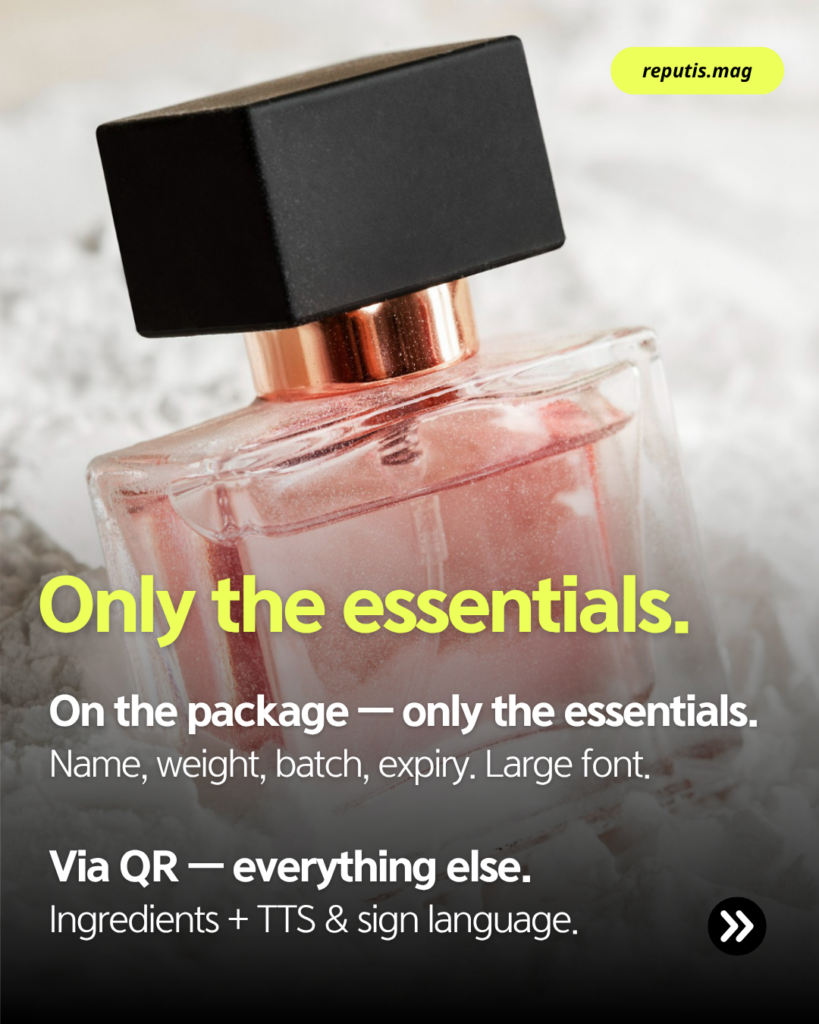
- On the package: Only essential information stays — product name, company name, net weight, batch number, and expiration date — printed in larger, readable font.
- Via QR code: All detailed information, including full ingredient lists, usage instructions, and precautions, becomes accessible through a QR code linking to the manufacturer’s website.
But the reform goes beyond convenience. In April 2025, Korea amended its Cosmetics Act to allow text-to-speech (TTS) and sign language video conversion codes alongside QR codes. MFDS is currently running a pilot with 10 companies (since March 2026) to test this accessibility feature, with formal guidelines expected by October 2026.
But Other Countries Are Doing This Too — So Why “World’s First”?
MFDS has described this initiative as a world first. That’s a fair claim — but it requires some nuance.
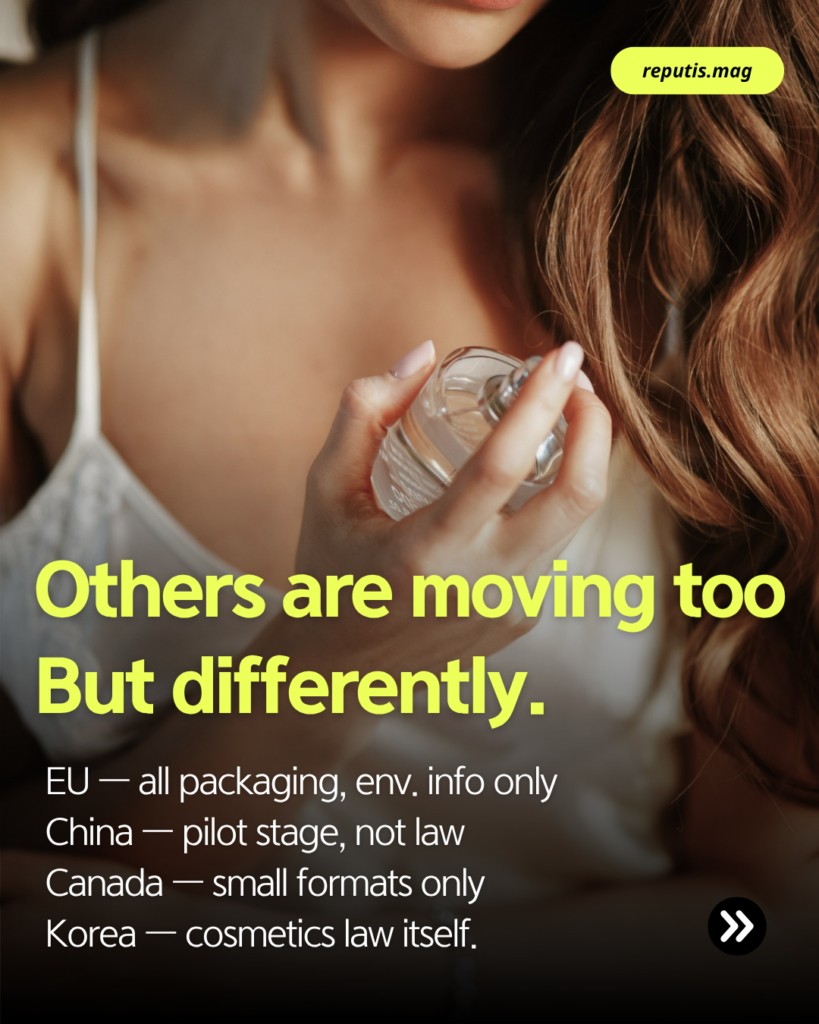
The EU’s Packaging and Packaging Waste Regulation (PPWR), which takes general effect on August 12, 2026, mandates digital identifiers (including QR codes) on packaging. However, PPWR applies to all packaging across all industries and focuses on environmental information — material composition, recyclability, and disposal. It is not a cosmetics-specific regulation, nor does it replace cosmetic product labeling requirements.
China launched an electronic label pilot in February 2025 across six regions (Beijing, Shanghai, Zhejiang, Shandong, Guangdong, and Chongqing), but it remains a pilot program — not yet legislated.
Canada’s revised Cosmetic Regulations, effective April 12, 2026, allow small-format products to disclose ingredient information on a website. But this is a limited exemption for space-constrained packaging, not a systemic overhaul of labeling obligations.
South Korea’s approach is different: it is amending the Cosmetics Act itself to create a legal basis for replacing mandatory physical label content with QR-based digital information. No other country has done this specifically for cosmetics at a national legislative level. That is what MFDS means by “world’s first.”
Why the Urgency? K-Beauty’s Global Stake
The timing is no coincidence. South Korea’s cosmetics industry is on an extraordinary run, and aligning with global digital labeling trends is now a competitive necessity.
- 2025 full-year exports: USD 11.43 billion — an all-time record, up 12.3% year-on-year (source: Korea Ministry of Trade, Industry and Energy).
- Global ranking: Korea overtook the United States in cosmetics exports for the first time in mid-2025, rising to world No. 2 behind France (source: Korea International Trade Association).
- 2026 momentum: March 2026 alone saw USD 1.193 billion in cosmetics exports — the highest single month on record — with Q1 cumulative growth exceeding 21% year-on-year (source: Ministry of Trade, Industry and Energy, April 1, 2026).
With exports now reaching 202 countries and the government eyeing a USD 15 billion export target, regulatory compatibility with the EU, China, Canada, and other markets is no longer optional.
What’s in It for the Industry?
The e-label system offers tangible benefits for cosmetics companies:
- Design freedom: Less label real estate devoted to fine print means more room for branding and creative packaging.
- Cost savings: Fewer label reprints and less packaging waste when regulations or formulations change — information updates happen digitally in real time.
- Sustainability: Reduced material use in labeling supports the broader shift toward eco-friendly packaging.
MFDS is also actively participating in the International Cooperation on Cosmetic Regulation (ICCR) e-labeling working group, engaging with regulators from 17 countries to explore harmonized digital labeling standards. Korea became a full ICCR member in 2020.
Key Dates Ahead
| Timeline | Milestone |
|---|---|
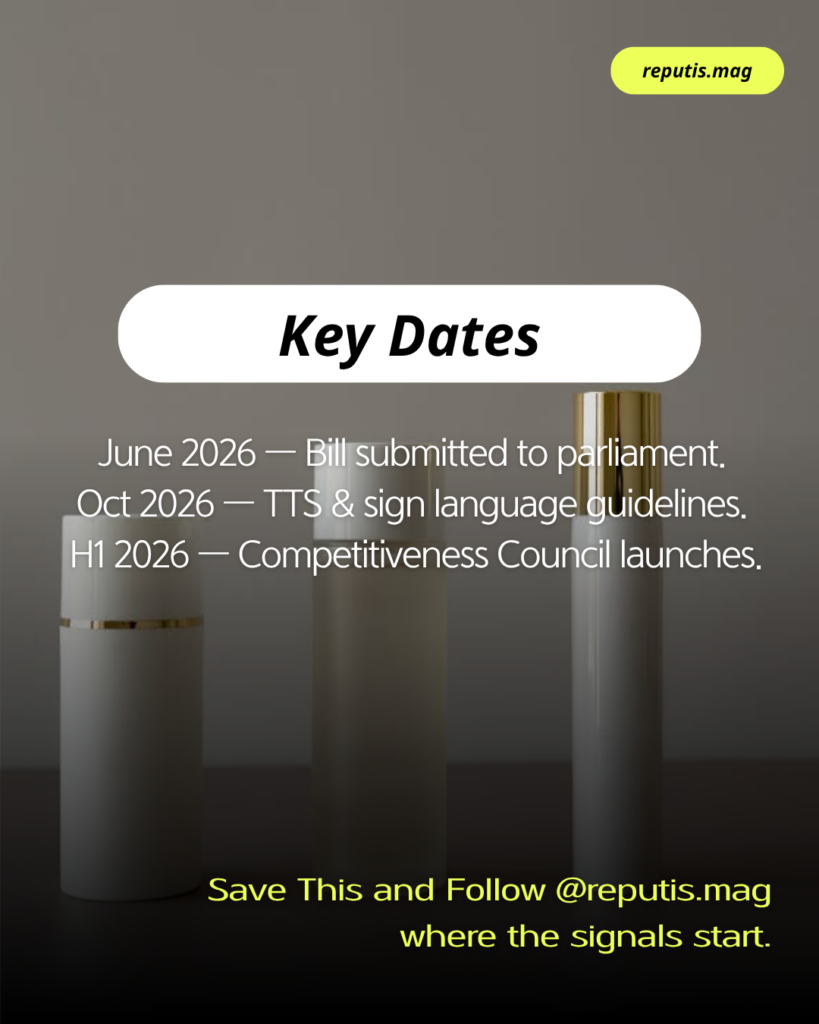
| June 2026 | Cosmetics Act amendment (e-label legal basis) submitted to National Assembly |
| October 2026 | Guidelines for TTS and sign language conversion codes |
| H1 2026 | Launch of inter-ministerial Cosmetics Competitiveness Council |
The Bottom Line
South Korea is betting that the future of cosmetic product labeling is digital. By writing QR-based information delivery into law — a first for any country’s cosmetics legislation — Korea is positioning itself not just as the world’s second-largest cosmetics exporter, but as a standard-setter in how beauty products communicate with consumers.
For global brands sourcing from or exporting to Korea, this is one regulatory shift worth watching closely.
Sources: Ministry of Food and Drug Safety (MFDS) policy briefing (March 12, 2026); Ministry of Trade, Industry and Energy monthly export reports; Korea International Trade Association (KITA) trade statistics; EU Regulation 2025/40 (PPWR); Cosinkorea.com; Cosmorning.com
:: Recent Posts ::
- National Museum of Korea Is Now the World’s 3rd Most Visited Museum – And It’s Still Free (2026)
- Cosmetics e-Labels? South Korea to Become the 1st Country to Legislate
- Bored and Hungry Seoul : World’s 1st NFT Burger Joint in Seongsu-dong
- Haus Nowhere Seoul: The Ultimate Guide to Seongsu’s 14-Story Future of Retail (2026)
- NVIDIA × L’Oréal: How GPUs Are Entering the Beauty Lab at GTC 2026


당신이 좋아할 만한

Dynamite Kiss Star Ahn Eun Jin’s 10kg Weight Loss Secret: Han River Running & The Gimbap Trick

The Complete Lady Dua Beauty Breakdown – 3 Lip Products, 1 Iconic Look
