Korea House Seoul: The Hidden Hanok Cafe Most Tourists in Subway line 3 Walk Right Past
What Is Korea House?
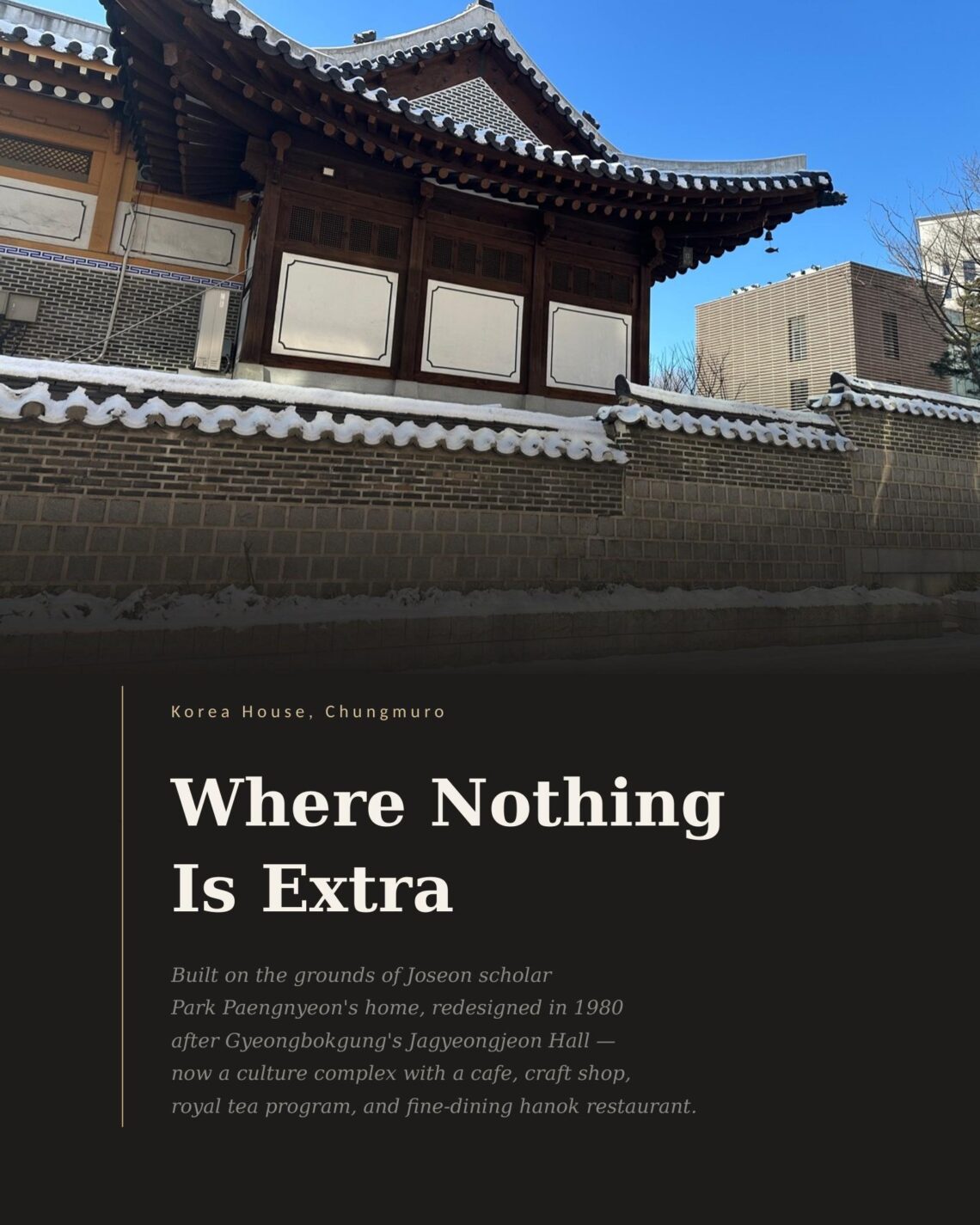
Korea House is a traditional culture complex in Chungmuro, central Seoul. It sits on the grounds where the Joseon-era scholar Park Paengnyeon once lived — one of the legendary Six Martyred Ministers. The current building was designed in 1980 by master carpenter Shin Eung-su, modeled after the Jagyeongjeon Hall at Gyeongbokgung Palace, and officially opened to the public in 1981.

Today it’s operated by the Korea Cultural Heritage Foundation and houses a fine-dining hanjeongsik restaurant, the Kohojae premium royal court tea program, a traditional wedding venue, a cooking class series, and — tucked just inside the entrance — a quiet little cafe that most visitors don’t even realize is there.


The Sarang Café & Art Shop

The Sarang Café & Art Shop sits right inside the Korea House entrance, next to the gift shop. It’s a casual, walk-in space — no reservation needed, no dress code, regular cafe prices. Traditional Korean tea served in handmade ceramic cups, with the kind of quiet that central Seoul almost never offers.
The gift shop section is run by the Korea Cultural Heritage Foundation and carries quality-verified handmade Korean crafts: celadon, lacquerware, hanji paper goods, horn ornaments, textiles, and ceramics.
The small white vase with red winterberries that appears in these photos is exactly the kind of thing you’ll find here — understated, handmade, and grounded in the Korean aesthetic concept of yeobaek-ui mi, which treats empty space itself as a design element.
If you’re looking for a meaningful souvenir from Seoul — something handmade and traditional rather than mass-produced — this shop is one of the better-curated options in the city.
Kohojae: The Premium Royal Court Tea Experience
Kohojae is a separate, ticketed experience inside Korea House. The name means “a home for those who love old things.” It’s a seasonal program where you receive a personal tray of seven to eight traditional Korean confections — rice cakes, fruit preserves, and hangwa — made from seasonal ingredients, alongside a traditional tea.
Each session includes a Chunaengjeon court dance performance at the beginning.
Kohojae details:
- Price: 25,000 won per person
- Duration: 120-minute sessions, three times daily
- Booking: Reservation-only through Catchtable (search “한국의집 고호재”)
- Closed: Mondays, Seollal, and Chuseok
- Note: Kohojae was closed for renovation from July 2025 through early March 2026. Check @koreahouse_official on Instagram for the latest seasonal menu before booking.
This is not the casual cafe. It sells out regularly.
What Else Is Inside Korea House
Hanjeongsik Fine Dining
Korea House runs a full royal court cuisine restaurant — one of the few places in Seoul where you can experience multi-course hanjeongsik in a traditional hanok setting. The head chef has been recognized by the Michelin Guide and the Asia’s 50 Best Restaurants awards.
- Lunch: 12:00–15:00 (last order 13:00)
- Dinner: 18:00–22:00 (last order 19:30)
- Price: From approximately 50,000 won (lunch) / 100,000 won (dinner)
- Booking: Catchtable or phone (02-2266-9101)
Traditional Korean Weddings
Korea House is one of Seoul’s most popular traditional wedding venues. Ceremonies are held in the courtyard in traditional hanbok, with full ceremonial rituals.
Dam: One-Day Korean Cooking Class
“Dam” is a one-day cooking class series where participants learn to prepare traditional Korean dishes. Sessions are announced periodically — check the Korea House website or Instagram for upcoming dates.
Cultural Performances
The complex hosts traditional performances including pansori, fan dance, pungmul percussion, and samulnori throughout the year.
How to Get to Korea House

Address: 10 Toegyero 36-gil, Jung-gu, Seoul
By subway: Chungmuro Station (Line 3 & Line 4), Exit 3. Turn around from the exit and walk uphill for about two minutes. You’ll see the traditional gate on your left.
By bus: Get off at Toegyero 3-ga / Hanok Village / Korea House bus stop. Buses 104, 421, 463, 507, and Namsan circular bus 01 stop here.
Parking: Small on-site lot available.
Nearby: Namsangol Hanok Village is a three-minute walk away. The Pildong mural alley and Myeongdong shopping district are both within a ten-minute walk.
Why This Place Works for Your Wellness Routine
You don’t need to spend 25,000 won on the Kohojae experience to benefit from this place — though it’s worth it if you can get a reservation. The Sarang Café alone offers something increasingly rare in central Seoul: a genuinely quiet room in a traditional building, a warm cup of tea in a handmade ceramic, and ten minutes with nothing to do.
Korean beauty culture has always treated rest as foundational — not as a luxury add-on, but as the baseline that everything else builds on. This is a good place to practice that.
Quick Reference
| Sarang Café | Kohojae Tea | Hanjeongsik | |
|---|---|---|---|
| Price | Regular cafe prices | 25,000 won/person | From ~50,000 won |
| Reservation | Walk-in | Catchtable (required) | Catchtable or phone |
| Duration | As long as you want | 120 minutes | ~90 minutes |
| Includes | Tea + craft shop access | Tea + confections + dance | Multi-course royal cuisine |
| Vibe | Casual, quiet | Elevated, cultural | Fine dining, formal |
Save This for Your Seoul Trip
Korea House is one of those places that rewards people who know it’s there. The hanjeongsik restaurant is well-known, and Kohojae has become increasingly popular — but the Sarang Café, the craft shop, and the building itself are still pleasantly uncrowded.
If you’re visiting Namsangol Hanok Village (and you should), add this as a stop. They’re a three-minute walk apart.
📍 Korea House — 10 Toegyero 36-gil, Jung-gu, Seoul 🚇 Chungmuro Station (Line 3·4), Exit 3 🌐 koreahouse.or.kr 📸 @koreahouse_official
All photos taken on-site by the author. Korea House is operated by the Korea Cultural Heritage Foundation.
:: Recent Articles ::
- Glass Hair: 3 K-Beauty Products for the Trend That Replaced Glass Skin (2026)
- The Complete Lady Dua Beauty Breakdown – 3 Lip Products, 1 Iconic Look
- Korea House Seoul: The Hidden Hanok Cafe Most Tourists in Subway line 3 Walk Right Past
- BLACKPINK × National Museum of Korea: The Collab That Changed K-Culture
- 13 Seoul R&B NAVY GLOW’s Seoul Night, Got Me In My Zone — A Trapsoul About Being a Foreigner


당신이 좋아할 만한

Seoul Christmas Markets 2025: Your Complete Guide to Holiday Magic in Korea
Seoul Bus Strike | How to Stay Informed – 7 Checklist for Expats and Foreign Residents