Heavy Metals in Lipstick: What Korea’s MFDS and Global Rules Actually Require (2026)
Heavy Metals in Lipstick: What Korea’s MFDS and Global Rules Actually Require (2026)
You reapply it without thinking — in the car mirror, after lunch, before a meeting.
Over a year, that adds up to hundreds of small doses on the most absorbent, most “edible” part of your face.
So it’s a fair question to ask: is the lipstick you wear every day actually safe? Should you be worried about heavy metals in lipstick?
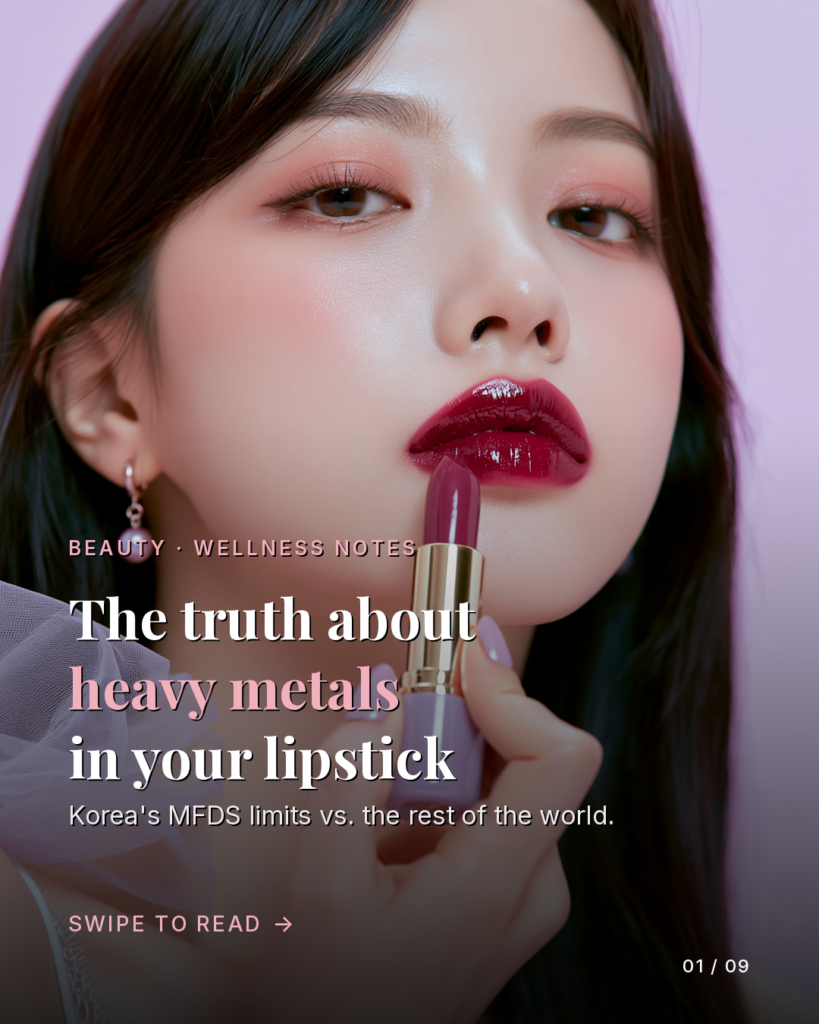
The honest answer is reassuring but not a simple “don’t worry about it.” The substances people worry about most — heavy metals like lead and cadmium — really are present in many lip products.
But they’re present as trace impurities, they’re capped by regulators in most major markets, and the levels actually measured in finished products tend to sit far below those caps.
The nuance is in how each country regulates, and why a smaller number on paper doesn’t always mean a stricter rule in practice.
This article walks through all of it: which substances matter, what Korea’s Ministry of Food and Drug Safety (MFDS) requires, how the United States, Washington State and the European Union compare, and what the real-world data says. It’s written for readers who care about cosmetic regulation — not to alarm, but to give you an accurate map.
Disclaimer: This is general information, not medical or legal advice. Regulatory limits change over time, so for anything decision-critical, check the current text from the relevant authority. Sources are listed at the end.
Why lips are a special case
Most cosmetics sit on the skin. Lipstick is different in two ways that make exposure modeling more conservative.
First, the lips themselves. The skin of the lips is thin, lacks the protective outer layer (stratum corneum) found elsewhere, and is densely vascularized. That combination makes the lips more permeable than, say, the skin on your forearm.
Second — and this is the big one — you eat some of it. Through drinking, eating, licking and simply talking, a portion of what’s on your lips ends up swallowed. Estimates of how much lipstick a regular wearer ingests over time vary widely, but the principle is settled: lip products have an oral exposure route that a blusher or an eyeshadow does not.
This matters because it changes how regulators assess risk. As you’ll see below, the US FDA explicitly models lead exposure from lip products the same way it models lead exposure from food, precisely because ingestion is the dominant pathway. So when people ask, “shouldn’t lipstick have a stricter limit than other makeup?” — the more accurate framing is that the ingestion route is already supposed to be baked into the safety assessment behind the limit.
What’s actually in question: heavy metals in lipstick, etc. as impurities
When headlines say a lipstick “contains lead,” it’s easy to picture a manufacturer spooning lead into a mixing vat. That’s not what’s happening.
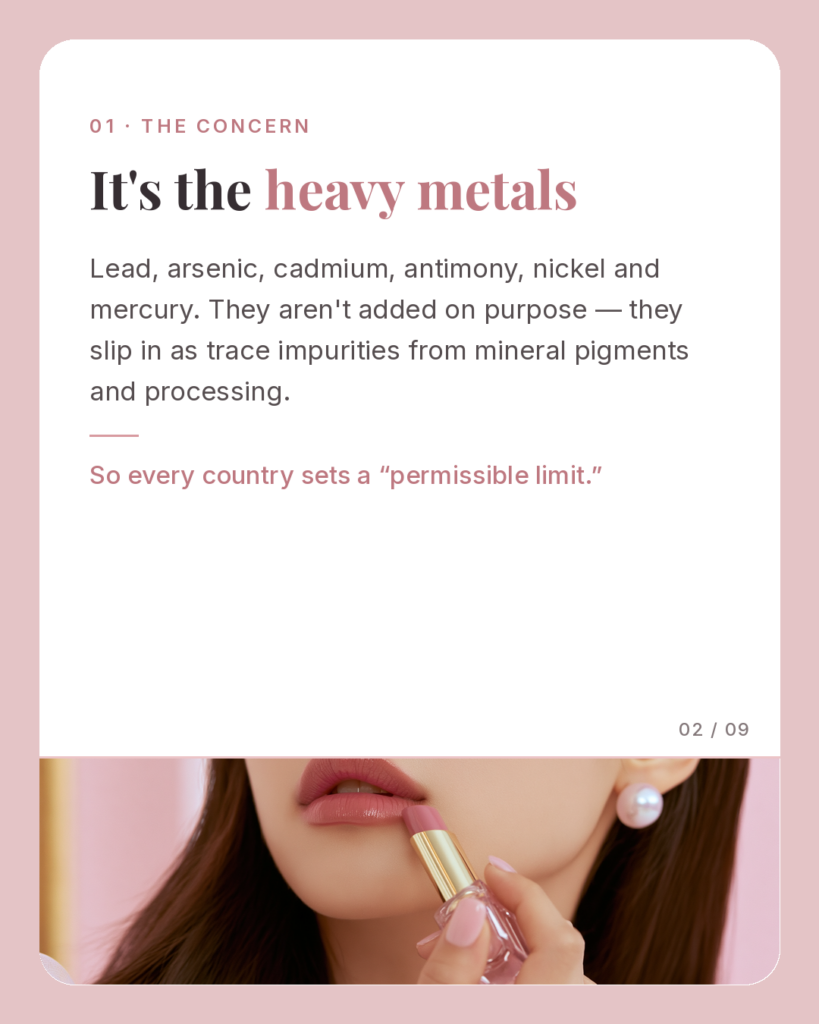
Heavy metals — lead, arsenic, cadmium, antimony, nickel and mercury are the usual suspects — are not added on purpose. They arrive as contaminants, mostly through two doors:
- Raw materials, especially colorants. Many pigments are mineral-derived (iron oxides, ultramarines, micas and other earth-sourced materials). Heavy metals are naturally abundant in soil, rock and water, so mineral inputs almost inevitably carry trace amounts.
- Manufacturing and storage. Processing equipment, water and packaging can introduce additional trace contamination.
Because these metals are geologically ubiquitous, removing them to absolute zero is not technically feasible at scale.
Regulators around the world accept this reality and respond the same conceptual way: prohibit the deliberate use of these metals as ingredients, then set a “permissible limit” (also called a detection or tolerance limit) for the unavoidable trace amounts. The debate between regulators isn’t really whether to allow traces — it’s how low the ceiling should be and how compliance is verified.
Keep that framing in mind, because it’s the key to comparing countries fairly.
Korea’s MFDS limits: the baseline regarding heavy metals in lipstick, etc.
South Korea regulates cosmetics through the MFDS, and the heavy-metal ceilings live in the “Regulation on Safety Standards, etc. for Cosmetics.” Lipstick is classified as a color cosmetic, so it inherits the color-cosmetic limits rather than a bespoke “lip only” standard.
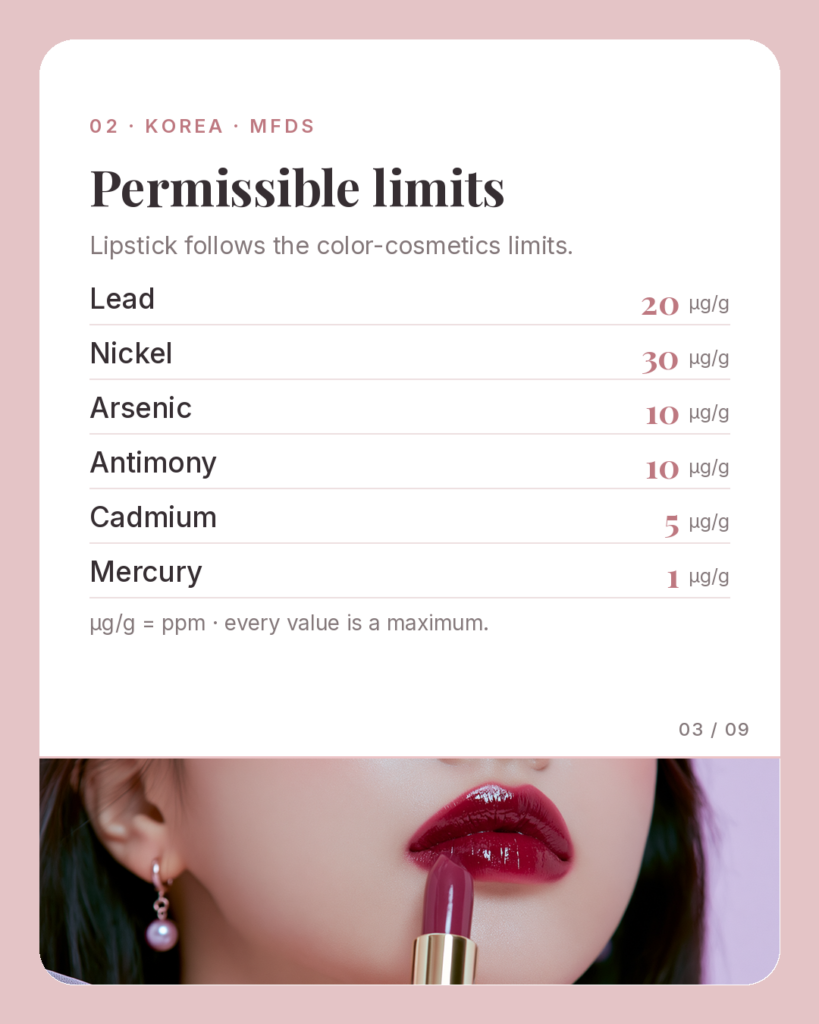

Here are the headline heavy-metal limits for distributed cosmetics:
| Heavy metal | Permissible limit |
|---|---|
| Lead | 20 µg/g (50 µg/g for clay-based powder products) |
| Nickel | 35 µg/g eye makeup · 30 µg/g color cosmetics · 10 µg/g others |
| Arsenic | 10 µg/g |
| Mercury | 1 µg/g |
| Antimony | 10 µg/g |
| Cadmium | 5 µg/g |
A few notes that matter for accuracy:
- µg/g is the same unit as ppm (parts per million). When you see “10 ppm” in US discussions and “10 µg/g” in Korean rules, those are identical.
- Every value above is a maximum — a ceiling for unavoidable traces, not a target or an “expected” amount.
- Because lipstick is a color cosmetic, the relevant nickel ceiling is 30 µg/g, and lead is 20 µg/g.
The MFDS doesn’t stop at heavy metals. The same regulation caps several other substances that can show up unintentionally:
| Substance | Permissible limit |
|---|---|
| 1,4-Dioxane | 100 µg/g |
| Methanol | 0.2% (v/v) — 0.002% (v/v) for wet wipes |
| Formaldehyde | 2,000 µg/g — 20 µg/g for wet wipes |
| Phthalates (DBP, BBP, DEHP — combined) | 100 µg/g total |
One correction worth flagging, because it circulates incorrectly in a lot of beauty content: methanol’s limit is a volume percentage (0.2% v/v), and it’s formaldehyde that carries the 2,000 µg/g figure. The two often get swapped. If you’ve seen “methanol: 2,000 µg/g,” that’s the formaldehyde number mislabeled.
Among these, phthalates deserve a moment of extra attention. They’re widely discussed as endocrine disruptors, so even though they’re regulated as a combined trace limit, they’re the group many safety-conscious readers track most closely.
So that’s the Korean baseline: clear, numeric, legally binding ceilings, with lip products folded into the color-cosmetics category.
[Regarding Heavy Metals in Lipstick] The United States: a different philosophy
Here’s where international comparisons get interesting — and where a lot of “Korea is lax / the US is strict” takes fall apart.
The FDA’s 10 ppm is a recommendation, not a binding limit
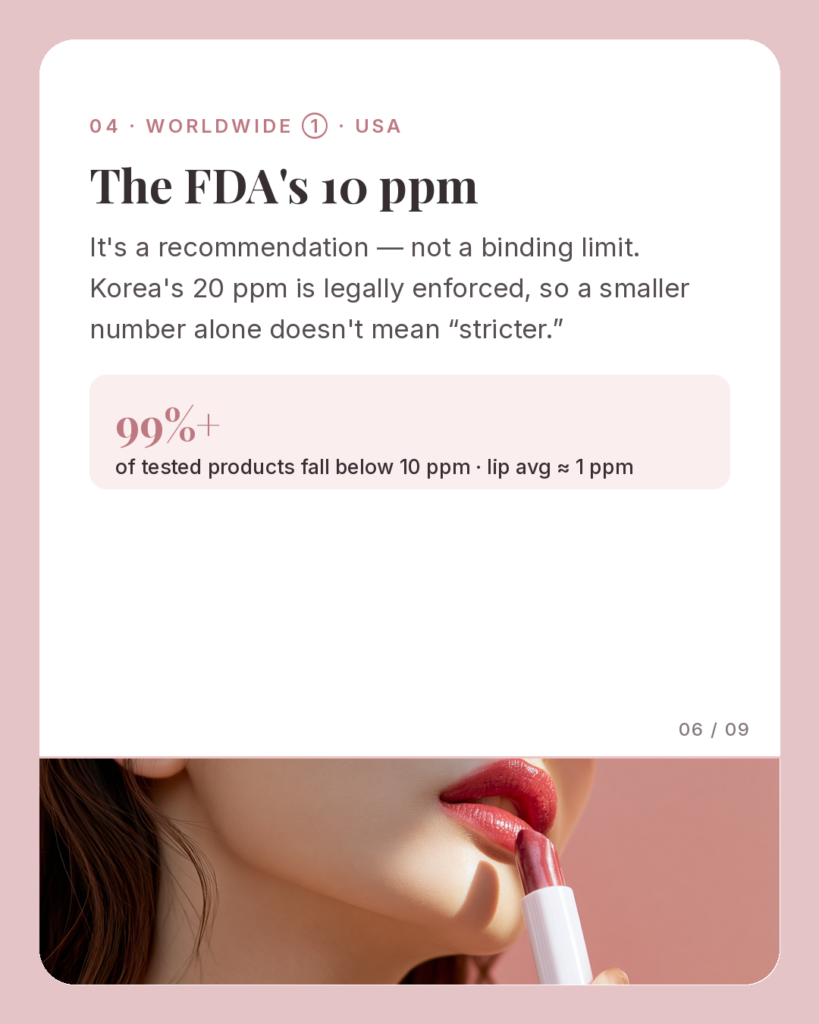
In the US, the FDA has issued guidance recommending a maximum of 10 ppm of lead as an impurity in lipstick and other externally applied cosmetics. The critical word is guidance. It is a recommendation to industry, not a legally enforceable ceiling in the way Korea’s 20 µg/g is.
That single distinction reframes the whole comparison. On paper, “10” looks stricter than “20.”
But Korea’s 20 µg/g is a hard, enforceable limit, while the FDA’s 10 ppm is a non-binding target the agency encourages manufacturers to meet.
A lower number that’s advisory is not automatically “stricter” than a higher number that’s mandatory.
The honest takeaway: don’t rank regimes by the headline figure alone — ask whether it’s enforced.
Why the FDA landed on 10 ppm — and why it isn’t alarmed
The FDA didn’t pick 10 ppm arbitrarily, and the reasoning is genuinely reassuring.
When the agency surveyed the market, it found that the overwhelming majority of products were already well under that ceiling: in its testing, over 99% of products fell below 10 ppm, and the average lead level in lip products it analyzed was roughly 1 ppm — an order of magnitude below the recommended maximum.
The agency also explained its exposure logic in plain terms: because lead exposure from lipstick happens mainly by swallowing, the FDA estimated exposure using the same approach it uses for lead in food.
Having done that, it concluded that cosmetics meeting the recommended maximum do not pose a health risk, and it did not advise consumers to change the lip products they use.
So the US picture is: a non-binding 10 ppm recommendation, near-universal compliance in practice, and an agency that frames the issue as “set a sensible ceiling to keep the tail of the distribution in check,” not “there’s a crisis on your vanity.”
The state-level shift: Washington, Oregon, Vermont
The more aggressive movement in the US is happening at the state level.
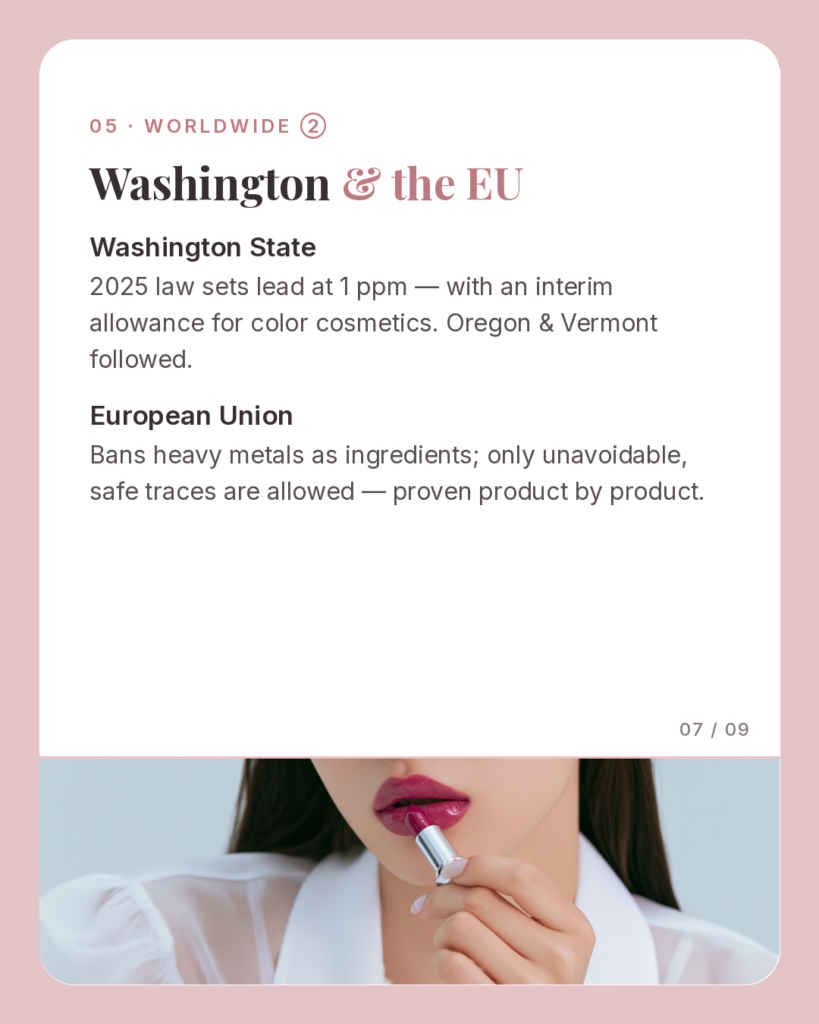
Washington State’s Toxic-Free Cosmetics Act (TFCA) is the headliner. Among its provisions, it sets a lead limit of 1 ppm — a dramatic tightening relative to the FDA’s 10 ppm recommendation — with the lead provision taking effect in 2025.
But the real-world picture comes with an asterisk.
Recognizing that hitting 1 ppm is technically difficult for some formulations, Washington’s implementing agency adopted an interim enforcement policy — effectively a temporary safe harbor.
Under it, the strict 1 ppm threshold isn’t enforced against manufacturers who meet more lenient interim conditions; color cosmetics, for instance, are given room up to around 5 ppm (with additional conditional allowances and monitoring for products in higher ranges).
In other words: the statutory ambition is 1 ppm, but the operational reality for color cosmetics is being phased in.
Washington isn’t alone. Oregon and Vermont have adopted similar laws, signaling a broader state-level trend toward tighter cosmetic-metal rules even as the federal recommendation holds at 10 ppm.
[Regarding Heavy Metals in Lipstick] The European Union: ban first, prove safety second
The EU takes a structurally different route, and understanding it dissolves a common misconception (that the EU sets a special numeric “lipstick limit”).
Under the EU Cosmetics Regulation (Regulation (EC) No 1223/2009), heavy metals such as lead, cadmium, arsenic, antimony and mercury are prohibited as cosmetic ingredients — they appear on the regulation’s list of banned substances (Annex II). You cannot formulate with them.
What about the unavoidable traces? The regulation allows them only when their presence is technically unavoidable under good manufacturing practice and the product remains safe for human health. Crucially, the EU generally doesn’t publish a single across-the-board numeric ceiling the way Korea does. Instead, the burden sits on the manufacturer to demonstrate safety product by product, documented in the product’s safety report. Trace presence is tolerated case by case, on evidence — not waved through under a universal number.
Because the EU doesn’t set one harmonized figure for every category, manufacturers lean on guidance values and national reference points. Germany’s BfR, for example, publishes orientation values that are frequently cited across the industry — on the order of lead under ~2 mg/kg generally, and around 5 mg/kg for certain makeup powders such as blushers and eyeshadows.
So the EU model is, in a sense, conceptually strict in a different dimension: it forbids these metals as ingredients outright and demands case-by-case safety proof for residual traces, rather than handing out one permissive number that applies to everything.
[Regarding Heavy Metals in Lipstick] Side-by-side: the same problem, three philosophies
It helps to see the approaches together. The point isn’t to crown a winner; it’s to show that “strictness” is multi-dimensional.
| Region | Lead approach | Legal nature | Notable feature |
|---|---|---|---|
| Korea (MFDS) | ≤20 µg/g (color cosmetics) | Binding limit | Clear numeric ceilings per metal; lip = color cosmetics |
| US FDA | ≤10 ppm | Recommendation (guidance) | 99%+ already below; exposure modeled like food |
| US — Washington | 1 ppm statutory | Binding law (with interim allowance) | Color cosmetics phased in (~5 ppm interim); OR & VT similar |
| EU | No single numeric ceiling | Ingredient ban + case-by-case | Traces allowed only if unavoidable and proven safe |
Read across that table and the headline-number trap becomes obvious. Korea’s “20” is enforceable; the FDA’s “10” is advisory; Washington’s “1” is law but softened by an interim policy; the EU’s approach skips a universal number entirely in favor of an ingredient ban plus documented safety. Different philosophies, not a simple ladder from lax to strict.
So should you worry about heavy metals in lipstick
This is the part that should lower your shoulders a little.
Regulatory ceilings describe the worst the law tolerates. They don’t describe what’s typically in the product on your shelf. And on that front, measured levels tend to sit far below the limits.
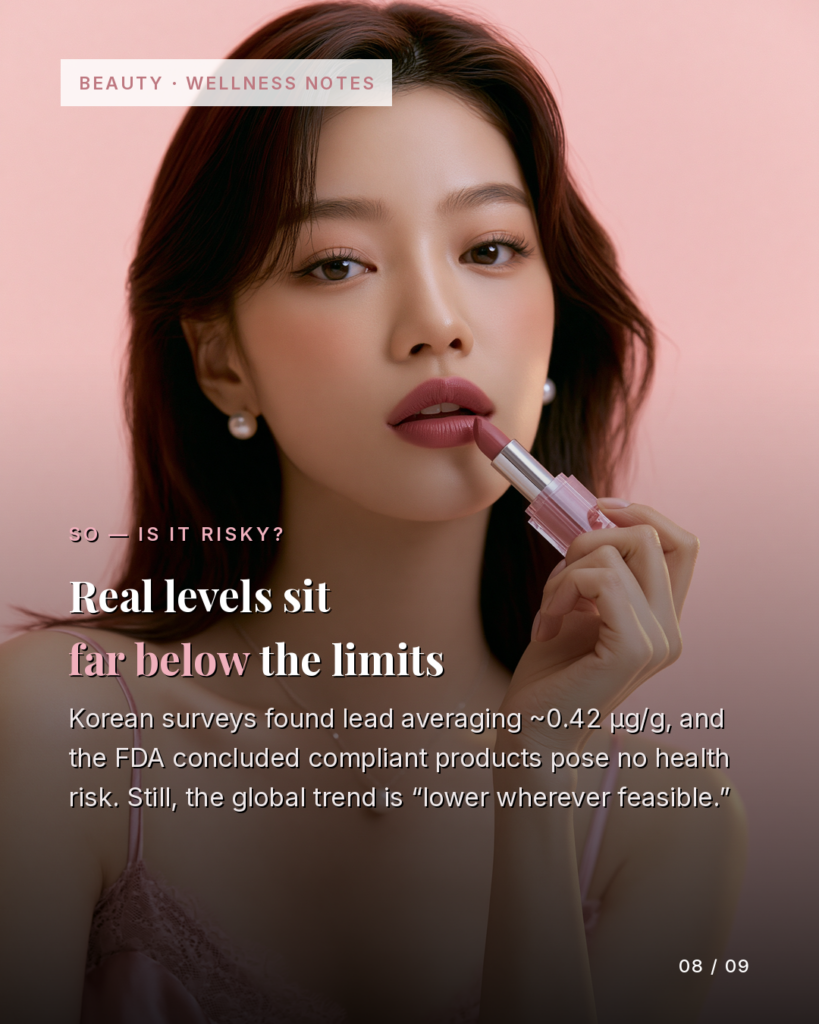
- In Korea, surveys of distributed cosmetics have found heavy metals consistently below the legal ceilings — with lead averaging on the order of ~0.42 µg/g in one study, and other metals (arsenic, cadmium, antimony, nickel) likewise well under their respective limits, mercury frequently undetected.
- In the US, recall the FDA’s own numbers: over 99% under 10 ppm, lip-product lead averaging about 1 ppm, and an explicit conclusion that compliant products pose no health risk.
Two things are true at once, and good consumer information holds both:
- At the levels actually found, regulators don’t consider compliant lipstick a meaningful health hazard. This isn’t a fringe reassurance; it’s the stated position of major agencies that have measured the market.
- The global direction of travel is “lower wherever feasible.” Washington’s 1 ppm law, the EU’s ban-plus-proof model, and ongoing tightening elsewhere all point the same way. Lower-is-better is a legitimate goal even when “current levels” are already safe — because trace contamination is something manufacturing can keep squeezing down over time.
If you hold both, you land somewhere sensible: this is a manage-and-improve topic, not a panic topic.
A practical buyer’s checklist if you’re worried about heavy metals in lipstick
You don’t need a chemistry degree to make good choices. A few habits cover most of the real-world risk.
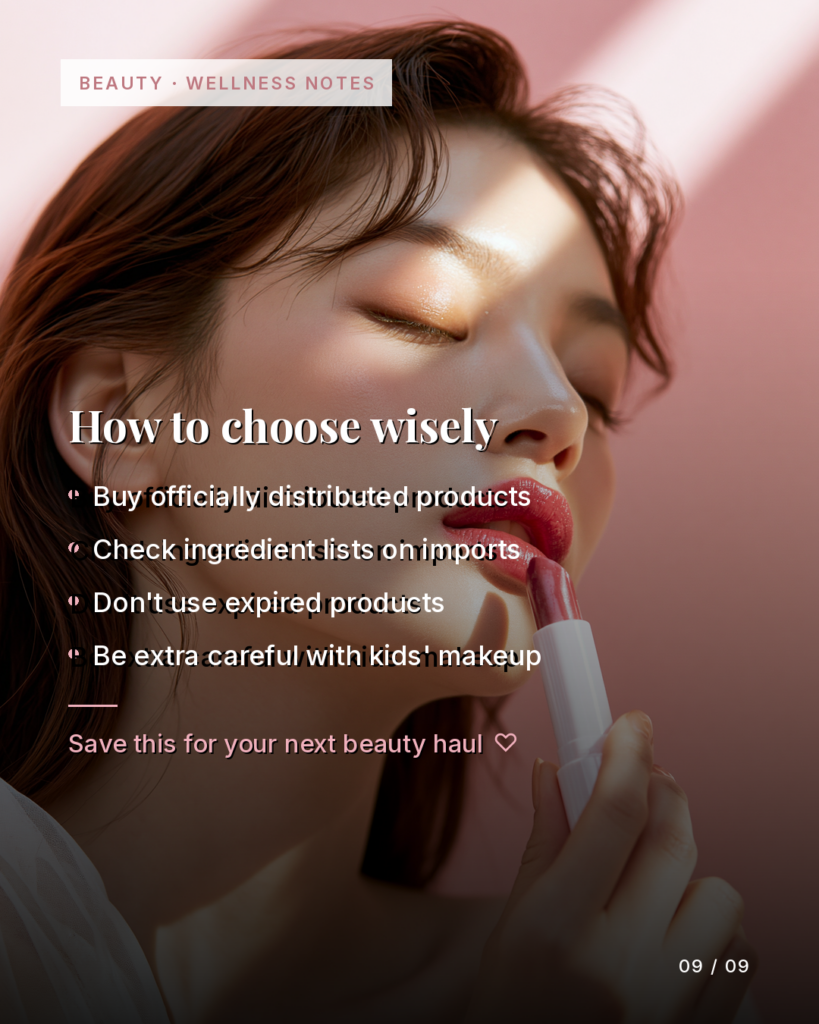
- Buy through official distribution. Products sold through legitimate domestic channels are subject to your market’s safety standards. This is the single most effective default.
- Scrutinize imports and gray-market buys. Cross-border purchases may fall under different (or weakly enforced) rules. Read the ingredient list, and be cautious with sellers who can’t tell you a product’s compliance status.
- Respect expiry dates. Expired products can degrade and change chemically. Past-date lipstick isn’t worth the gamble.
- Be extra conservative with children’s makeup. Kids’ products warrant more caution than adult ones — choose carefully and favor brands transparent about testing.
- Favor transparency over marketing buzzwords. “Non-toxic” and “clean” aren’t legally defined in most places. A brand that publishes how it tests for impurities tells you more than a label adjective does.
None of these require fear. They’re just the same instincts you’d apply to anything you use daily and partly ingest.
Frequently asked questions regarding heavy metals in lipstick
Does lipstick really contain lead? Often, yes — in trace amounts, as an unintentional impurity from mineral pigments and processing, not as a deliberate ingredient. The relevant question is whether it’s within the permissible limit, and in practice the vast majority of products sit far below it.
Is Korea’s standard weaker than the US standard because 20 is bigger than 10? Not so fast. Korea’s 20 µg/g is a binding limit; the FDA’s 10 ppm is a recommendation. Comparing the two requires accounting for enforceability, not just the number. Both regimes, in practice, see real-world products clustering well below their thresholds.
Why doesn’t lipstick have a stricter limit than other makeup, given that you eat some?
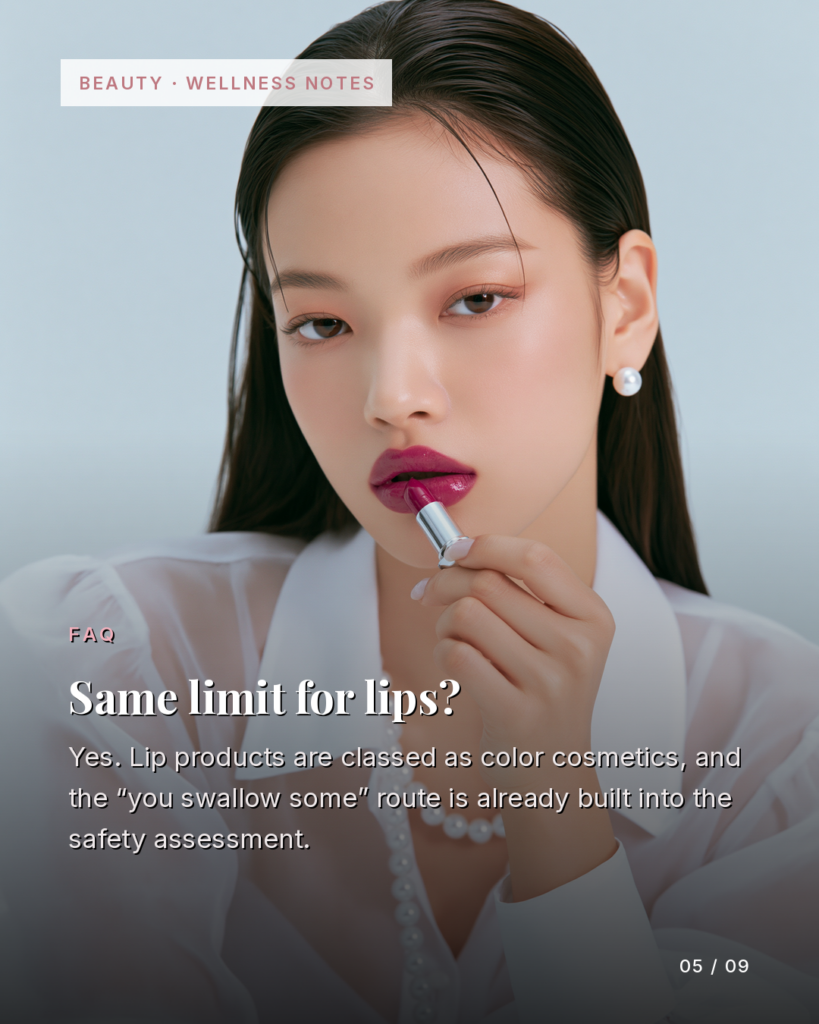
In systems like Korea’s, lip products are classified as color cosmetics and share that category’s limits. The ingestion route is meant to be reflected in the safety assessment behind the limit — for example, the FDA explicitly models lip-product lead exposure the way it models dietary lead. There’s an ongoing push in some regions for dedicated, lower lip limits, which is part of the broader tightening trend.
Are “clean” or “non-toxic” lipsticks automatically safer? Those terms usually aren’t legally defined, so they’re marketing language as much as anything. What actually protects you is whether a product complies with enforceable standards and whether the brand is transparent about impurity testing.
What about phthalates? Korea caps the combined total of three phthalates (DBP, BBP, DEHP) at 100 µg/g. Because phthalates are discussed as endocrine disruptors, they’re worth keeping on your radar even though they’re regulated as a trace limit.
Heavy metals in lipstick are real, but the story is one of managed trace contamination, not hidden poison.
Korea’s MFDS sets clear, binding ceilings and folds lip products into color cosmetics.
The US FDA recommends a 10 ppm lead target that almost all products already beat, while states like Washington push toward a much tighter 1 ppm with phased allowances.
The EU bans these metals as ingredients and demands case-by-case proof that any unavoidable traces are safe.
Across all of these systems, the measured reality is the same:
typical products sit comfortably below the limits, and regulators that have studied the market don’t consider compliant lipstick a meaningful health risk. The smart posture isn’t fear — it’s informed choosing, with an eye on a global trend that keeps nudging acceptable levels lower.
A smaller number doesn’t always mean a stricter rule. What matters is whether it’s enforced, how it’s verified, and what actually ends up on your lips.
Sources & further reading regarding heavy metals in lipstick
- Korea MFDS — Regulation on Safety Standards, etc. for Cosmetics, Article 6 (heavy-metal and impurity limits). Korean Law Information Center (law.go.kr).
- Korean survey of heavy metals in distributed cosmetics, Journal of Environmental Health Sciences (2019).
- US FDA — Lead in Cosmetics and Limiting Lead in Lipstick and Other Cosmetics (guidance, exposure modeling, and survey findings).
- US FDA — constituent update on draft guidance recommending a 10 ppm lead maximum (99%+ of products below the limit).
- Washington State Department of Ecology — Toxic-Free Cosmetics Act implementation and interim enforcement policy; Toxic-Free Future implementation summaries (Oregon & Vermont follow-on laws).
- EU — Regulation (EC) No 1223/2009 on cosmetic products (Annex II prohibited substances; technically-unavoidable-trace provisions); German BfR orientation values for heavy metals.
Regulatory figures are current as of writing and subject to change; verify against the primary sources above before relying on them.
:: Recent Posts other than [Heavy Metals in Lipstick] ::