“The Great Flood” 8 Things to Ponder upon – Unpacking the Wild Symbolism
“The Great Flood” 8 Things to Ponder upon – Unpacking the Wild Symbolism
The Water Itself: More Than Just H₂O
Let’s start with the obvious: there’s a LOT of water in this movie. But director Kim Byung-woo isn’t just showing off Netflix’s VFX budget. Water has been humanity’s ultimate symbol of rebirth and transformation since, well, forever.
In The Great Flood, water serves multiple symbolic functions:
Purification and Renewal: Just like Noah’s flood washed away the old world, the deluge here erases humanity 1.0 to make way for… whatever comes next. It’s apocalyptic housekeeping on a planetary scale.
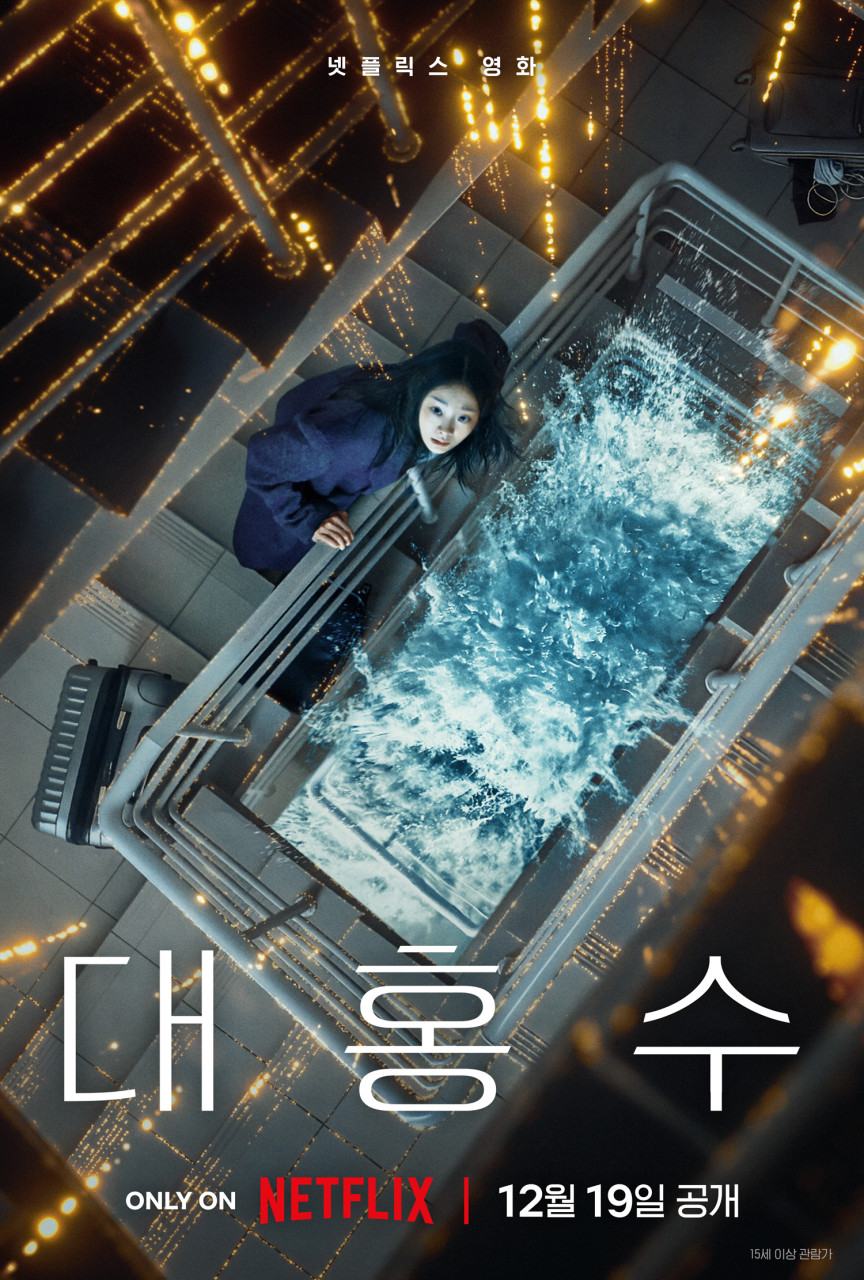
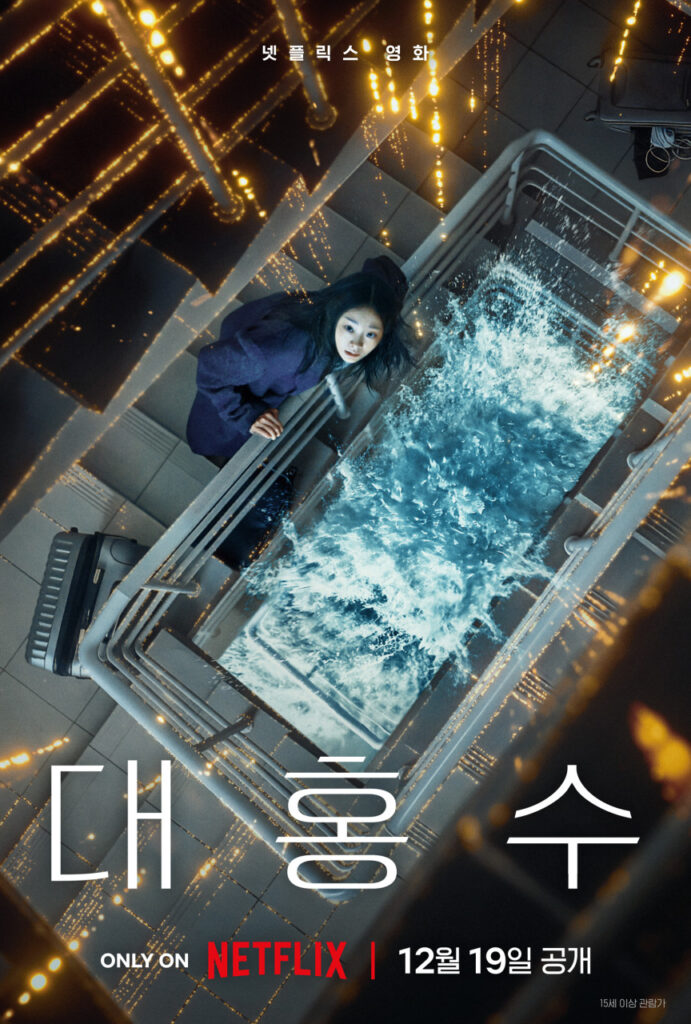
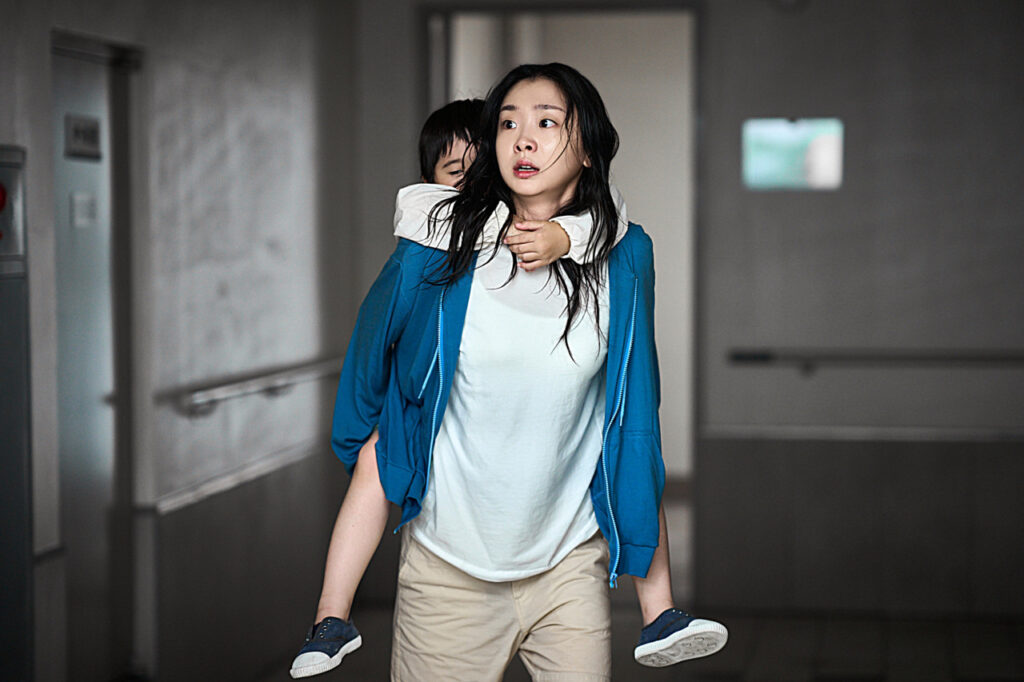
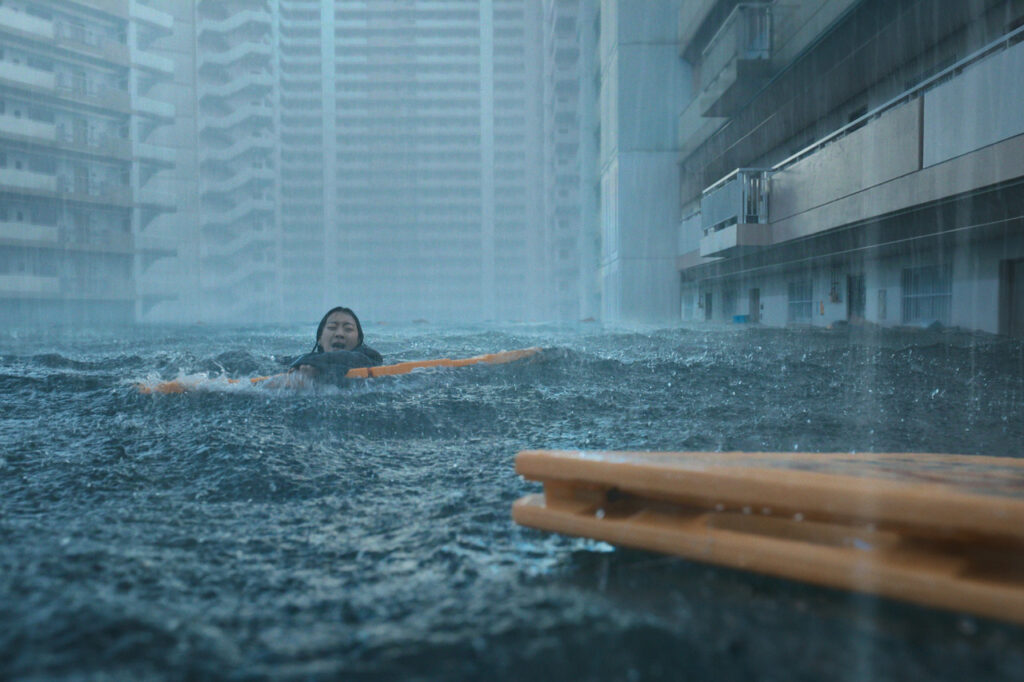
The Unconscious Mind: As the water rises floor by floor in the apartment building, we’re essentially watching An-na (Kim Da-mi) descend deeper into her own psychological depths. Each level is a layer of consciousness being stripped away, forcing her to confront what really matters: her love for her son.
Fluidity vs. Rigidity: The rigid, boxy apartment complex—that monument to modern Korean life—is literally being dissolved by nature’s most fluid element. Solid certainties meet liquid chaos. Who wins? (Spoiler: it’s complicated.)
Fun Fact: Water symbolism in Korean culture is particularly rich. The film’s Korean title “대홍수” directly references the biblical Great Flood, but it also echoes traditional Korean flood myths about renewal and cosmic cycles.
The Apartment: Korea’s Modern Ark
If you know anything about contemporary Korea, you know that apartments (아파트) aren’t just housing—they’re a whole social phenomenon. They represent economic status, family stability, and the Korean Dream itself.
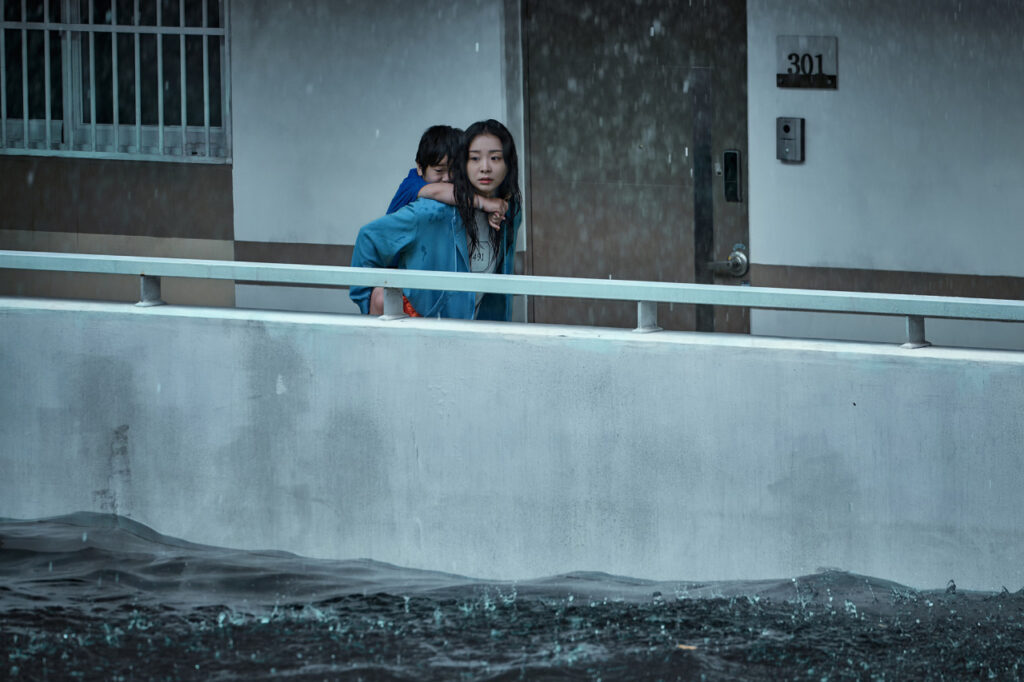
So what happens when you drown one?
The high-rise apartment in The Great Flood becomes a fascinating inversion of Noah’s Ark. Instead of a vessel that saves life by floating on the water, we have a structure that’s supposed to lift you above the problems of ordinary life… but ultimately can’t escape the rising tide.
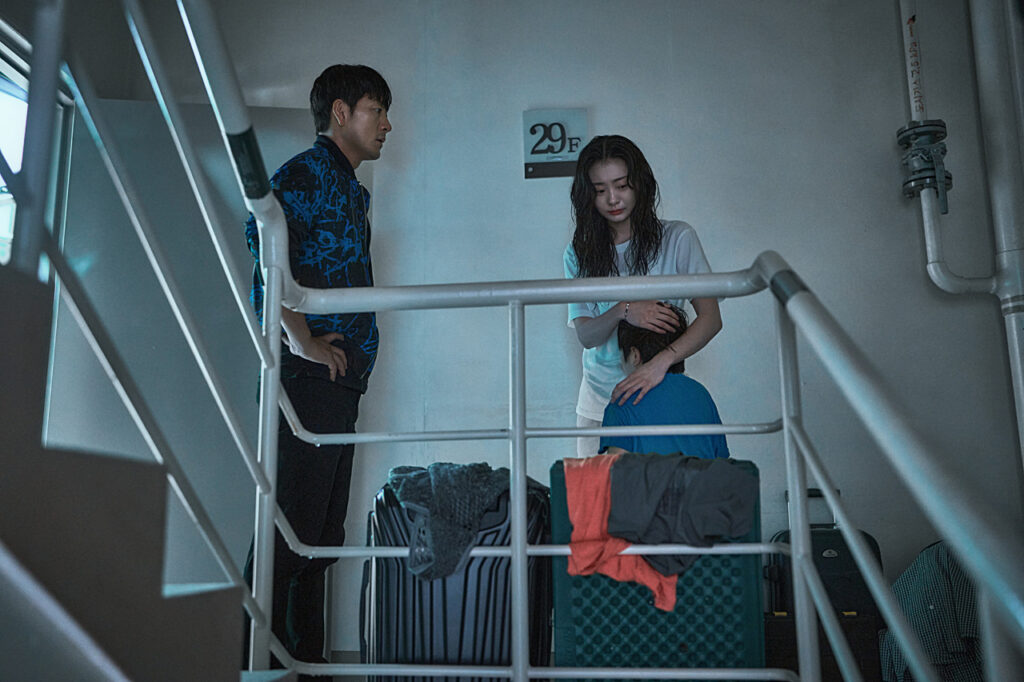
Vertical Hierarchy: Korean apartments are all about floor numbers—higher equals better. But when the flood comes, that hierarchy becomes a death countdown. The penthouse dream becomes a nightmare.
Collective Isolation: Apartments pack thousands of people into one building, yet everyone lives behind closed doors. Unit 303 is An-na’s prison, but also her sanctuary. It’s where she’s both utterly alone and never truly private—much like how AI learning simulations create isolated instances of reality.
The Time Loop: Learning Through Repetition
Here’s where the film gets deliciously meta. The reveal that An-na is living through repeated simulations—each one teaching an AI to understand maternal love—recontextualizes everything.
Eternal Return: The concept of cyclical time appears in philosophy from Nietzsche to Buddhism. Each loop is both identical and different, just like how machine learning processes data through countless iterations.
Sisyphean Motherhood: An-na’s task—save her child, fail, repeat—mirrors the endless, often thankless cycle of parenting itself. Every parent lives in a kind of loop: feed, clean, comfort, repeat. The film literalizes this metaphor through its SF premise.
Data as Divinity: The film suggests that by repeating these scenarios, the AI (and by extension, An-na herself) is being refined into something transcendent. It’s creation mythology for the digital age—God as a machine learning algorithm, perfecting humanity through infinite beta testing.
🎬 Director’s Easter Egg: Sharp-eyed viewers noticed the stickers on An-na’s face change each loop, the numbers on her t-shirts shift, and subtle costume details vary. These aren’t continuity errors—they’re breadcrumbs showing us the iterations of the simulation. Even the seemingly random debris in the apartment changes position slightly. It’s like a Where’s Waldo of existential dread!
The Child: Humanity’s Last Hope (Literally)
Six-year-old Ja-in isn’t just a cute kid in peril. He’s the MacGuffin, the meaning, and the mirror all at once.
Innocence and Instinct: While An-na’s love is being “learned” and “optimized” by AI, Ja-in represents pure, untested human emotion. He doesn’t know he’s in a simulation. His fear, his trust, his love—they’re real in a way that calls into question what “real” even means.
The Future Incarnate: The film’s premise is that humanity needs to be replaced by a “new humanity.” Ja-in, paradoxically, represents both what we’re losing and what we’re trying to preserve. He’s the DNA sample of human emotional capacity.
The Observer Effect: In quantum physics, observation changes the observed. Ja-in’s presence forces An-na to act, to feel, to choose. Without him, there’s no data to harvest. He’s the catalyst that makes love measurable.
The Emotion Engine: Can You Code a Mother’s Heart?
The central conceit—teaching an AI to feel maternal love—is where The Great Flood goes full Black Mirror meets Terrence Malick.
The Turing Test of the Soul: If an AI can perfectly replicate a mother’s desperate love, is it still “just code”? The film doesn’t give easy answers, but it does ask: what’s the difference between genuine emotion and behavior that’s indistinguishable from it?
Motherhood as Data: There’s something deeply unsettling (and fascinating) about the idea that the most profound human experience—a parent’s love—can be reduced to patterns and algorithms. It’s both reductive and oddly validating. Even AI needs to learn to love. Even machines can’t escape motherhood’s importance.
The Ghost in the Shell: An-na’s gradual realization that she might herself be part of the simulation raises questions about consciousness. If you’re programmed to love your child, is your love any less real? The film suggests: probably not.
The Asteroid: Original Sin, Rebooted
The asteroid that triggers the flood is barely shown, but symbolically, it’s huge (again, pun intended).
Cosmic Indifference: Unlike most disaster films where human hubris causes the catastrophe (looking at you, The Day After Tomorrow), here it’s just… space rock. The universe doesn’t care about us. We’re not special. Ouch.
Hard Reset Button: The asteroid impact is literally a control-alt-delete for planet Earth. It’s the ultimate “have you tried turning it off and on again?” solution to the human experiment.
Determinism vs. Free Will: If the asteroid strike was inevitable and known in advance, what does that say about An-na’s choices within the simulation? Are we watching free will, or just a very complex algorithm playing out?
The Number 303: Symbolic Gold
Unit 303 is not random. In numerology, 3 represents creativity, communication, and growth—often associated with the trinity or the cycle of birth-life-death.
Having it appear twice (3-0-3) with a zero in the middle? That’s a loop, baby. A beginning, a void, and a new beginning. The whole movie’s structure in a door number. Mind. Blown.
The Twist: Reality as the Biggest Symbol
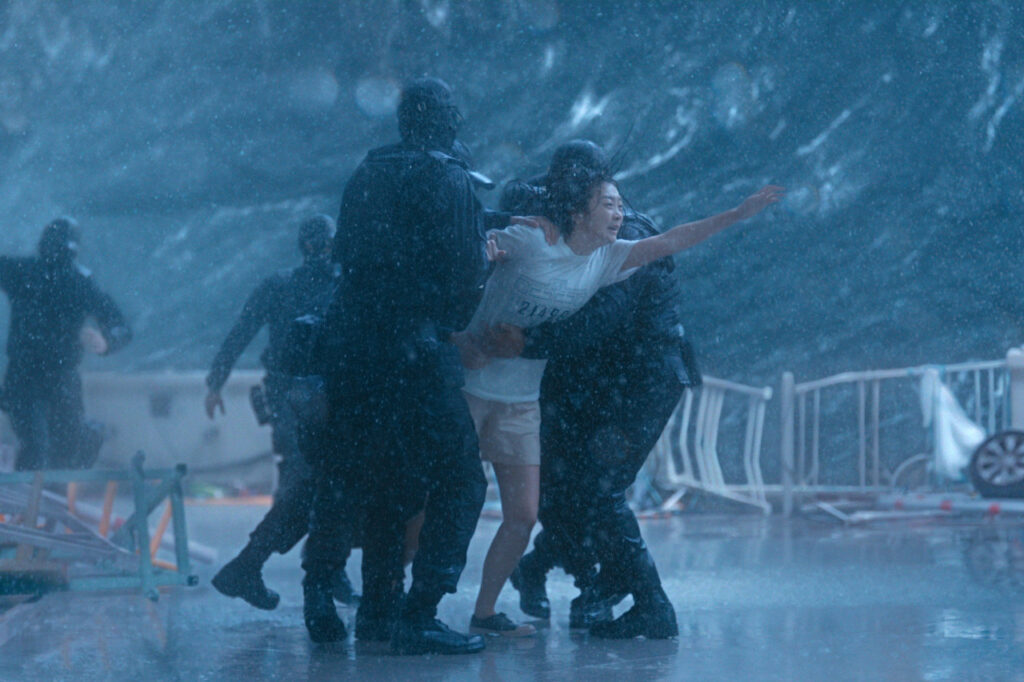
The film’s central revelation—that the “reality” we’ve been watching is a simulation—doesn’t just serve the plot. It’s a commentary on how we consume stories themselves.
We, the viewers, are also experiencing a simulation (the film). We’re also processing emotional data (the narrative). We’re also learning something about human nature through repetitive scenarios (genre conventions). The film is practicing on us what the Emotion Engine practices on An-na.
Meta-Cinema at its Wettest:
By revealing that nothing was “real,” the film forces us to ask what we gained from the experience. If An-na’s love in a simulation is valid, is our emotional response to a fictional film equally valid? (Spoiler: yes. Your tears are real even if the movie isn’t.)
The Verdict: Drowning in Ambition
The Great Flood isn’t perfect. It bites off maybe slightly more symbolism than it can chew (and that’s saying something in a movie about literal drowning). But you have to admire the audacity.
This is a film that uses biblical imagery, Korean social commentary, AI philosophy, quantum physics concepts, and motherhood as a universal language all at once. It’s messy. It’s ambitious.
It’s the kind of swing-for-the-fences filmmaking that we should encourage, even when it doesn’t completely stick the landing.
The water rises. The loops repeat. The AI learns. And we, the audience, are left with more questions than answers—which is exactly the point. In trying to teach a machine what it means to be human, the film reminds us that we’re still figuring it out ourselves.
“In a world where everything drowns, only love learns to swim.” — Absolutely no one from the film, but it sounds deep, doesn’t it?
What symbols did YOU catch in The Great Flood? Did I miss any watery metaphors? Drop your theories in the comments below! And if you’re still confused about whether the ending means we’re all in a simulation.
:: Check out other posts ::
- Glass Hair: 3 K-Beauty Products for the Trend That Replaced Glass Skin (2026)
- The Complete Lady Dua Beauty Breakdown – 3 Lip Products, 1 Iconic Look
- Korea House Seoul: The Hidden Hanok Cafe Most Tourists in Subway line 3 Walk Right Past
- BLACKPINK × National Museum of Korea: The Collab That Changed K-Culture
- 13 Seoul R&B NAVY GLOW’s Seoul Night, Got Me In My Zone — A Trapsoul About Being a Foreigner

당신이 좋아할 만한
Jongmyo Shrine Mystery: Why is a Goryeo King in a Joseon UNESCO Site?

Kim Go-eun’s Shocking Transformation: From Shaman to Psychopath | Netflix’s “The Price of Confession”