Which Brands Are Winning the War in Korean Coffee Market | 5 Switches to Watch
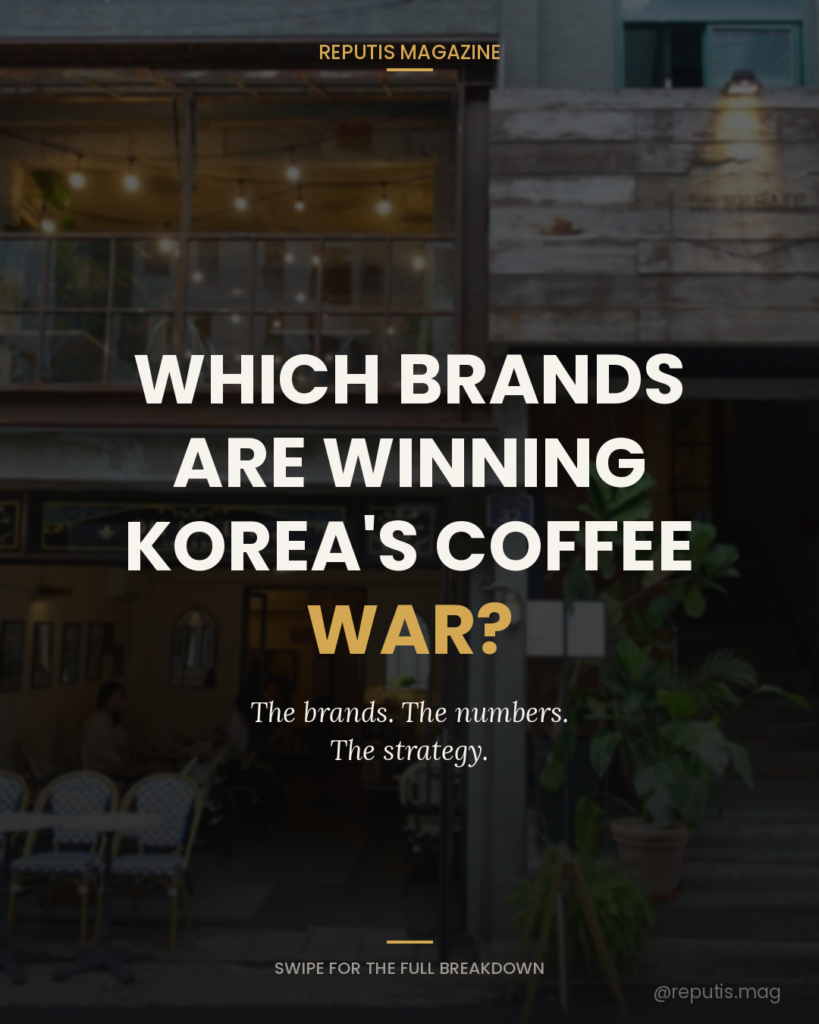
Korea has over 100,000 coffee shops. The market is splitting into two extremes — and the brands stuck in the middle are the ones struggling. Here’s who’s winning, how they’re doing it, and what it means if you’re looking at this market.
The Korean Coffee Market Is Splitting
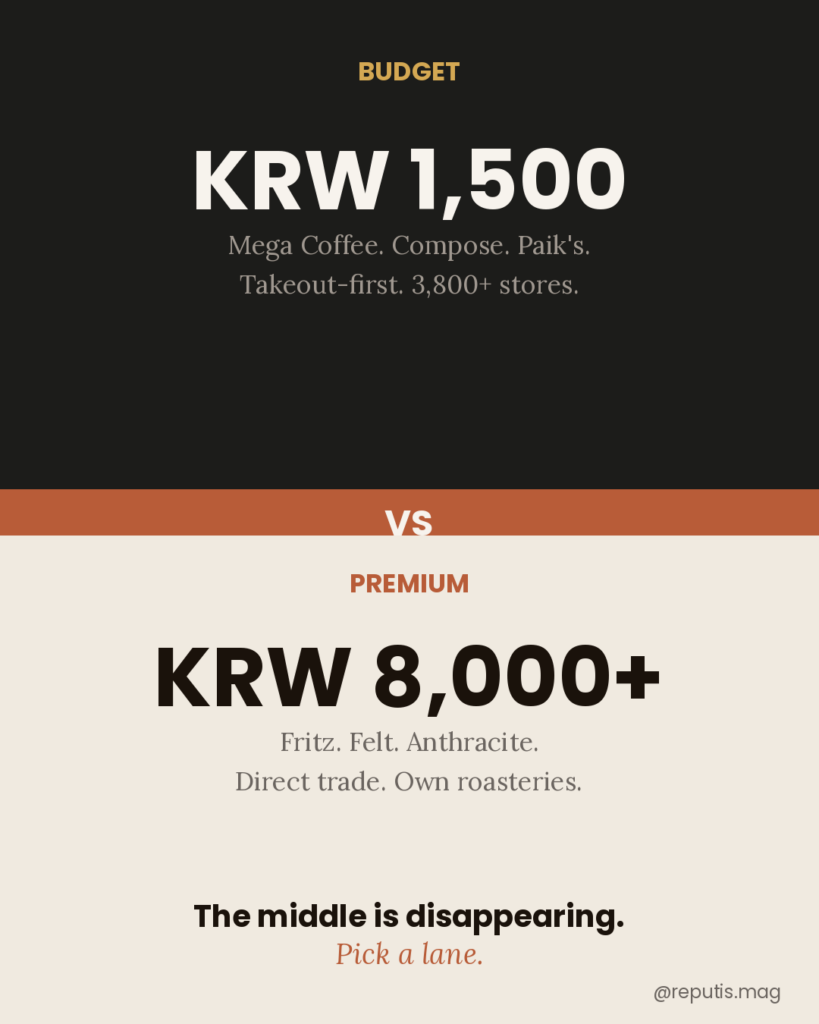
Walk into any Korean city and you’ll see the same pattern. On one side: budget chains selling americanos for KRW 1,500, opening new stores at a pace of several per day. On the other: specialty roasteries charging KRW 8,000 or more for a single pour-over, where the design of the space matters as much as the coffee itself.
The middle is disappearing. Brands like Eddiya and Coffee Bean, which once defined the mid-tier, are seeing store counts decline while both ends grow. If you’re entering this market, the first decision isn’t what kind of coffee you’ll sell — it’s which lane you’re in.
The Budget Tier in Korean Coffee Market: Mega Coffee
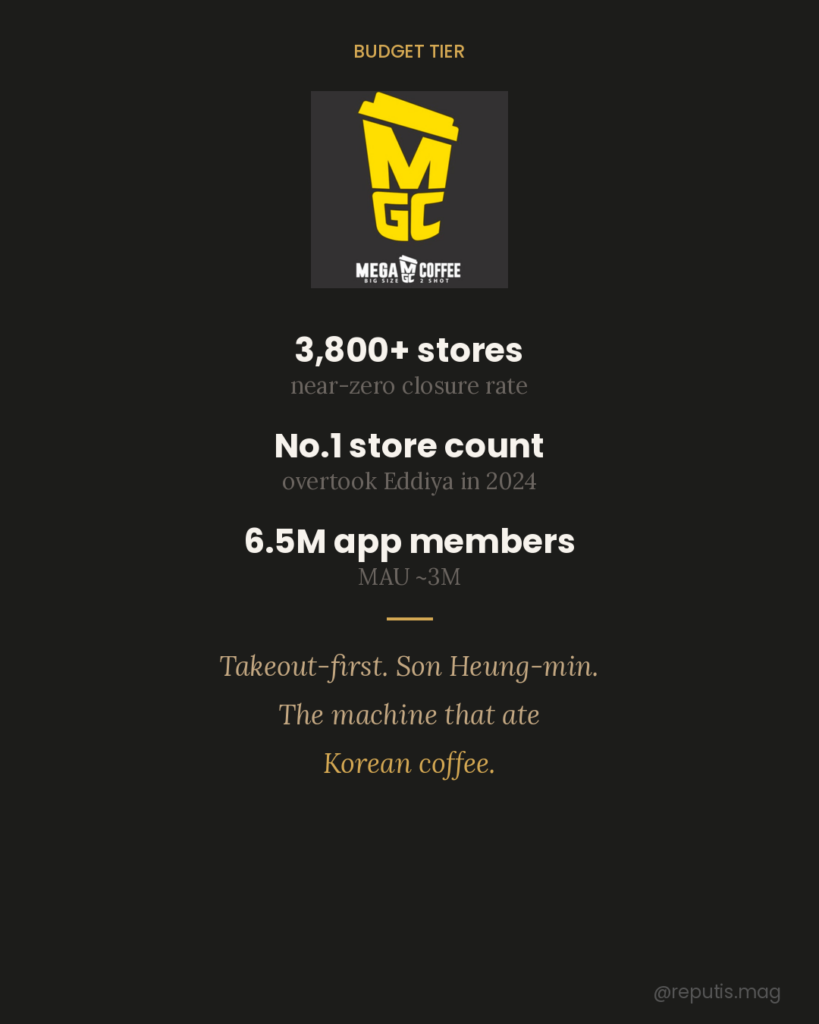
Mega Coffee is the brand that defines this moment in Korean coffee. With over 3,800 stores as of mid-2025, it holds the No.1 position in store count nationwide, having overtaken Eddiya in 2024. Its franchise closure rate is near zero — a remarkable figure in a market where competition is this fierce.
The app ecosystem tells another story. Mega Coffee has accumulated 6.5 million app members, with roughly 3 million monthly active users — second only to Starbucks in Korea. The brand built cultural relevance through partnerships with Son Heung-min and K-pop groups including ITZY and Super Junior, keeping the brand top-of-mind for younger demographics without repositioning the product itself.
The model is straightforward: small-footprint, takeout-first stores with low labor costs and high volume. It’s a machine — and it’s eating Korean coffee.
The Budget Tier in Korean Coffee Market: Compose Coffee
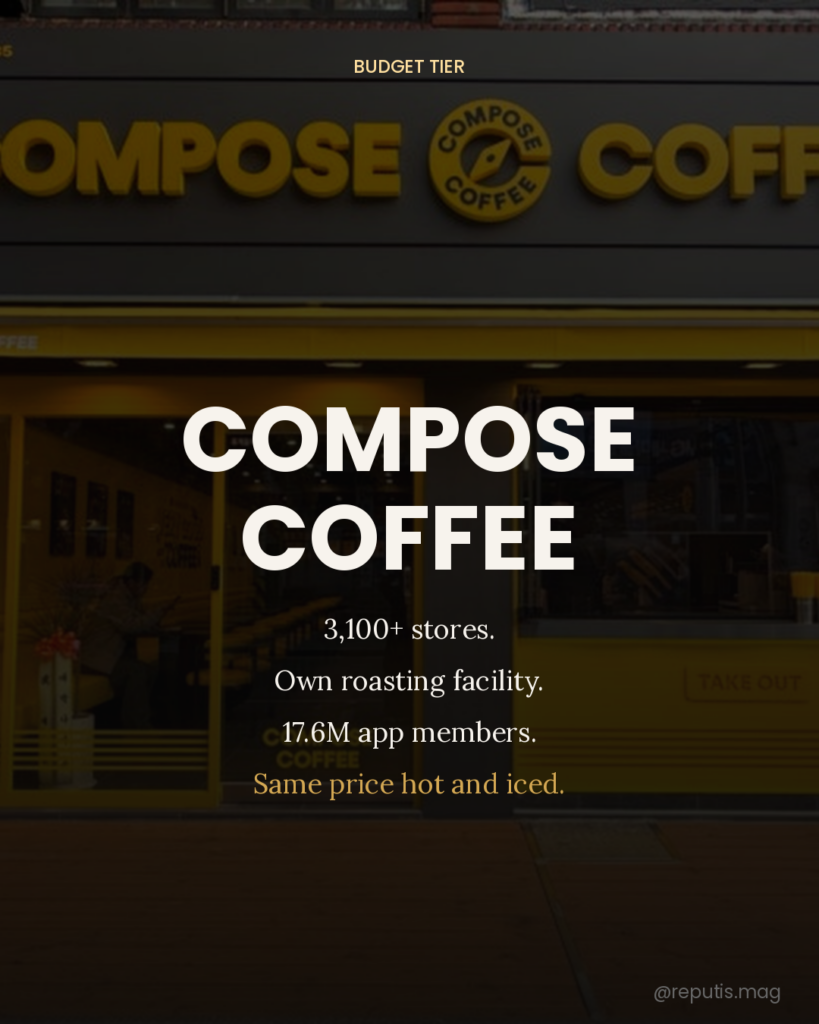
Compose Coffee has crossed 3,100 stores, with 3,000 reached in September 2025. What sets Compose apart is vertical integration: the company operates its own roasting facility, where a head roaster selects all green beans directly. This eliminates distribution margins entirely and keeps costs low without sacrificing consistency.
The app has 17.6 million registered members as of early 2026 — a number that grew significantly after BTS member V was signed as brand ambassador. Compose also made a deliberate choice that sounds small but signals clearly: hot and iced americanos are the same price. In a market where iced drinks typically cost more, this removes a friction point and builds trust.
The Budget Tier in Korean Coffee Market: Paik’s Coffee
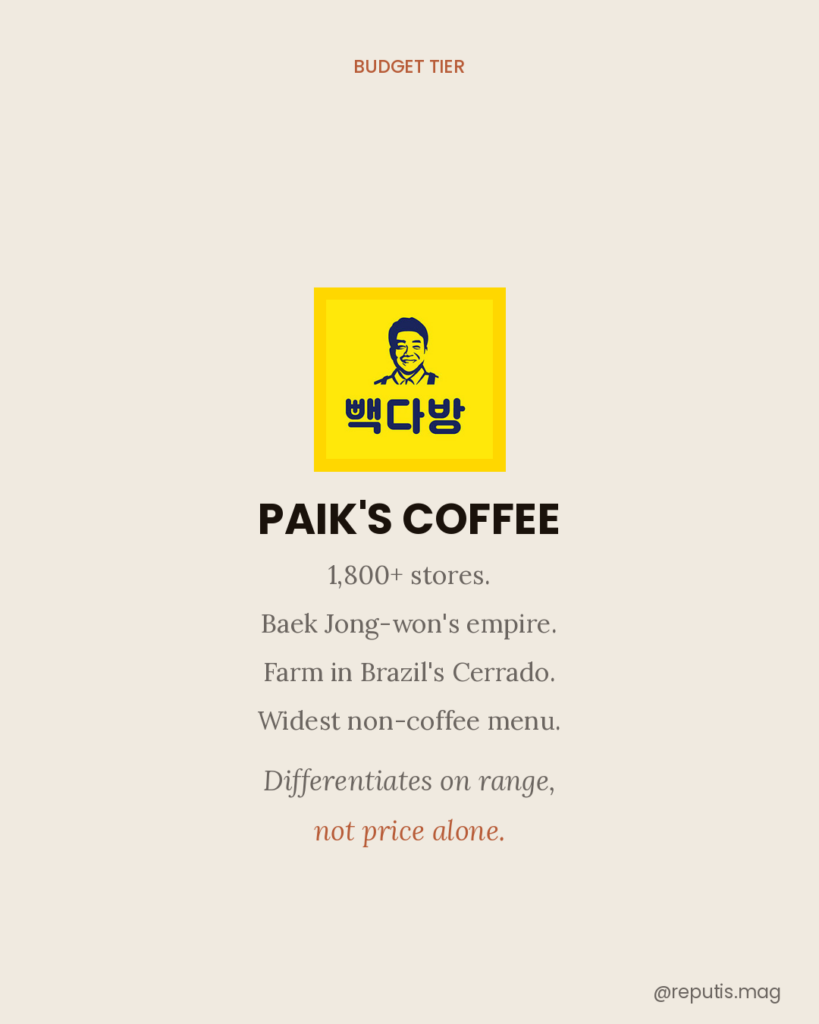
Paik’s Coffee operates over 1,800 stores, backed by the brand ecosystem of celebrity chef Baek Jong-won. The sourcing approach is distinctive: Paik’s uses beans from a dedicated farm in Brazil’s Cerrado region, processed through its own supply chain.
Where Paik’s differentiates most clearly is menu breadth. It offers the widest non-coffee menu in the budget tier — a strategic choice that matters as non-coffee beverages grow faster than coffee across the Korean market. Paik’s competes on range, not just price.
The Middle in Korean Coffee Market: Banapresso
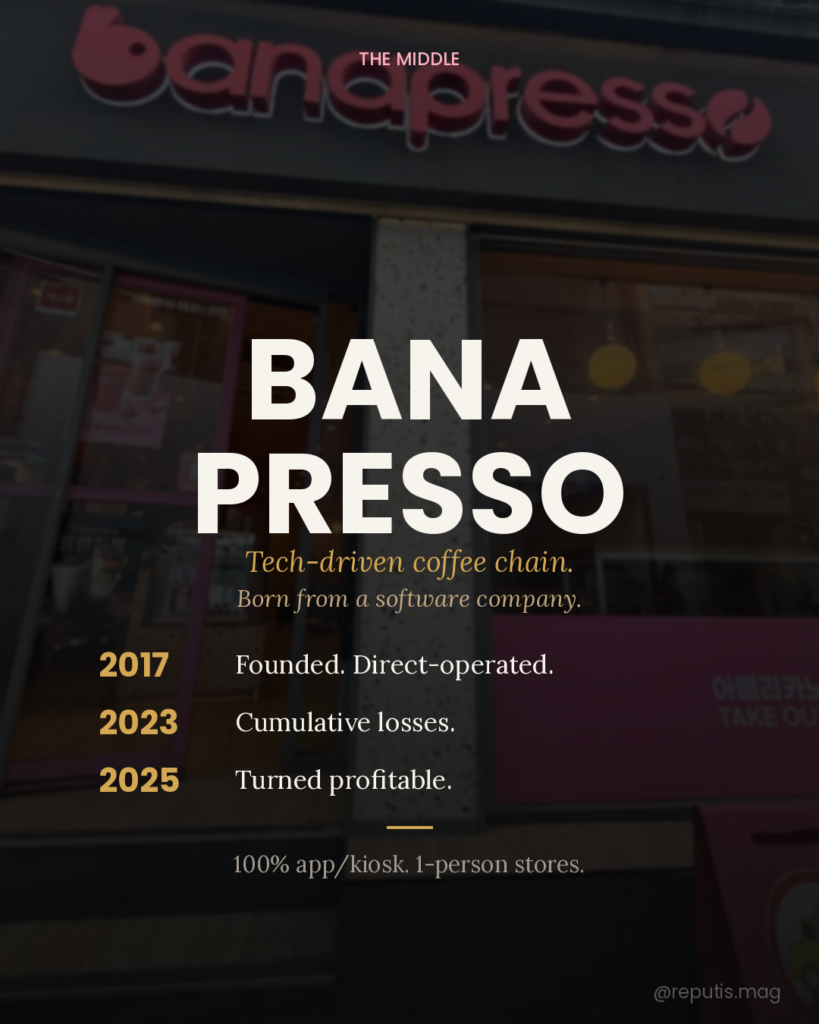
Banapresso is a case study in how hard the middle of this market is — and what a tech-driven approach looks like. Founded in 2017 as a subsidiary of Banaple, a mobile software company, Banapresso started as a 100% direct-operated chain: no franchises, all company-owned stores, with ordering exclusively through its proprietary app and in-store kiosks.
This meant years of losses. By 2023, the company had accumulated significant cumulative operating losses and reached capital impairment. But Banapresso’s bet was always on building the operating system first, then scaling. By 2025, the brand turned profitable.
The model is built around efficiency: one-person-operable stores, fully automated ordering, and data-driven operations from site selection to inventory. The company is now expanding through franchising and targeting 300 stores by 2026.
The Premium Tier in Korean Coffee Market: Fritz Coffee
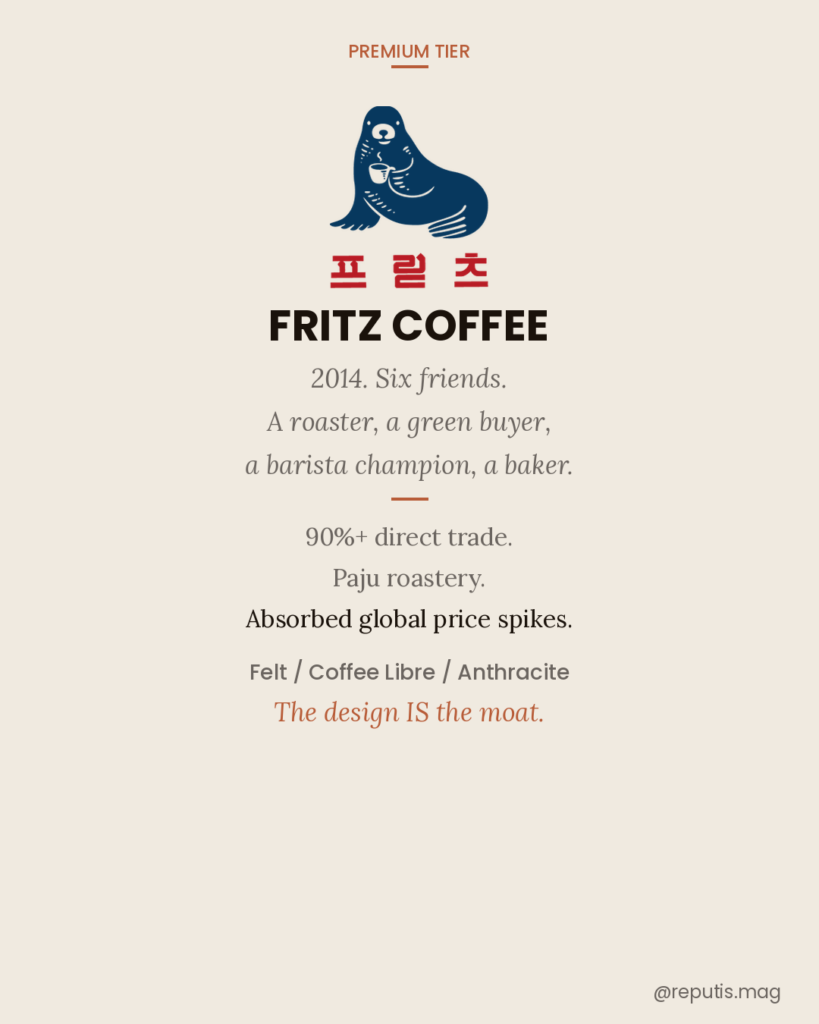
Fritz Coffee Company is the standard-bearer of Korean specialty coffee. Founded in 2014 by six friends — a roaster, a green coffee buyer, a national barista champion, and a baker among them — Fritz opened its first cafe in a renovated hanok in Seoul’s Mapo-gu district.
The brand’s “Korean Vintage” aesthetic, anchored by its now-iconic seal mascot, created one of the most recognizable visual identities in Korean food culture. But the identity isn’t just surface. Fritz purchases over 90% of its green beans through direct trade relationships and roasts at its own facility in Paju. When global coffee prices spiked, Fritz absorbed the cost increase rather than raising consumer prices — a decision that reinforced its community-first philosophy.
Fritz isn’t alone at this end. Felt Coffee roasts for over 300 wholesale cafe clients. Coffee Libre pioneered sustainable direct trade in Korea. Anthracite built industrial-chic destination spaces that international visitors specifically seek out. What connects them is a shared understanding: in Korea’s premium tier, the design, the sourcing narrative, and the spatial experience aren’t add-ons. They are the competitive moat.
5 Shifts to Watch in Korean Coffee Market
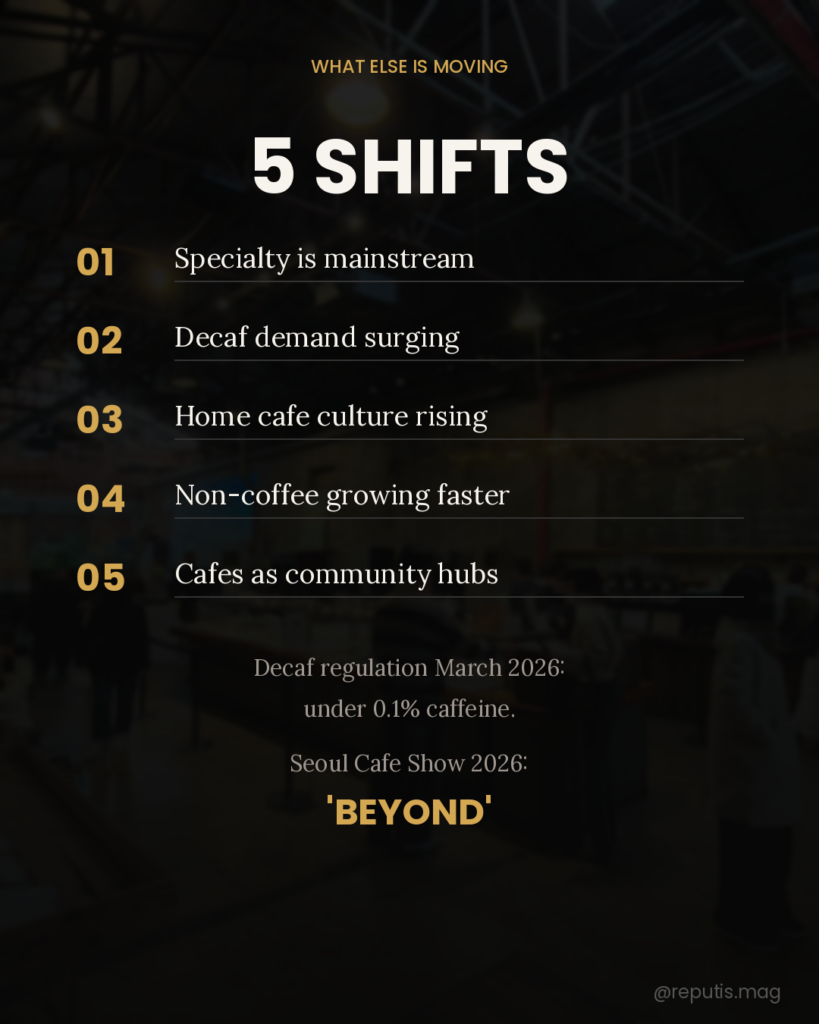
Specialty coffee has gone mainstream. Single-origin beans and processing method literacy — natural, washed, honey — are now standard expectations at mid-tier cafes, not just artisan roasters.
Decaf demand is surging. Starting March 2026, Korea enforces stricter labeling: products marketed as decaf must contain less than 0.1% caffeine content. Every major chain has expanded its decaf lineup in response.
Home cafe culture is taking hold. Pod machines, home grinders, and subscription bean services are growing across every price point. The home segment is no longer secondary — it’s a primary channel.
Non-coffee menus are growing faster than coffee. Matcha lattes, fruit refreshers, and tea variations featuring traditional Korean ingredients like yuzu and omija are becoming significant revenue contributors.
Cafes are becoming community platforms. The Seoul International Cafe Show chose “BEYOND: The Era of Resonance in Cafes” as its 2026 trend keyword. The most successful Korean cafes create reasons to visit beyond the drink itself.
What This Means
Korea has 100,000 coffee shops. They don’t need another one.
They might need a better one — but only if “better” means something the Korean consumer already cares about. The brands that are winning all have a precise answer to the question: why us, specifically? Mega owns operational efficiency. Fritz owns craft authenticity. Compose owns vertical integration. Banapresso owns tech-first operations.
If you’re looking at Korean coffee market, the first question to answer isn’t what kind of coffee you’ll sell. It’s what you bring that the existing 100,000 shops don’t already have.
:: Recent Posts ::